ЦИВИЛИЗАЦИИ: теория, история, диалог, будущее
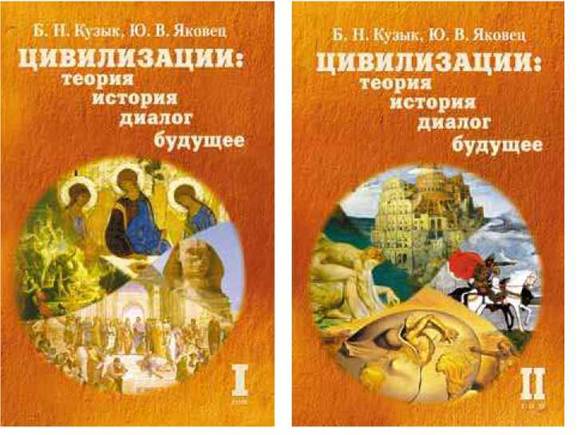
Проблема цивилизаций — их прошлое и будущее, динамика и взаимодействие — занимает ключевое место в общественных науках и социально-политической жизни XXI века.
Этой проблеме посвящена монография известных российских ученых — члена-корреспондента РАН Б.Н. Кузыка и академика РАЕН Ю.В. Яковца.В монографии читатель найдет оригинальную трактовку теории цивилизаций, циклично-генетических закономерностей их динамики, диалога и взаимодействия, обоснование закона сжатия исторического времени. В цивилизационном ракурсе исследуются демографические, природно-экологические, технологические, экономические, социально-политические, духовные факторы развития общества. История и будущее цивилизаций излагаются по трем историческим суперциклам. Впервые проведены клиометрические измерения динамики цивилизаций, ситуационный анализ и прогноз места России в геоцивилизационном пространстве XXI века.
Монография будет интересна не только ученым, аспирантам, студентам, но и государственным, политическим и общественным деятелям, всем переживающим за судьбы страны и человечества.
Том I. Теория и история цивилизаций
Оглавление
ПРЕДИСЛОВИЕ. А.Д. Некипелов. Новое слово
в общественных науках
ВВЕДЕНИЕ. Новый век — новое видение прошлого и будущего
Часть ПЕРВАЯ. ТЕОРИЯ ЦИВИЛИЗАЦИЙ
Глава 1. Становление и развитие теории цивилизаций
■ 1.1. Цивилизации: от многомерной реальности к научным категориям 1.2. Формирование теории цивилизаций 1.3. Теории цивилизаций XX века 1.4. Современные российские цивилизационные школы 1.5. Основы теории цивилизаций 1.5.1. Понятие и виды цивилизаций 1.5.2. Структура цивилизаций 1.5.3. Развертывание цивилизаций во времени ■ 1.5.4. Распространение цивилизаций в пространстве
■ 1.5.5.
Цивилизационный подход к истории и будущему человечества 1.5.6. Место теории цивилизаций в системе наукГлава 2. Цивилизационные циклы и кризисы
■ 2.1. Закономерности цикличной динамики социальных систем ■ 2.2. Циклы и кризисы в динамике локальных цивилизаций 2.3. Цикличность динамики мировых цивилизаций 2.4. Исторические суперциклы в развитии глобальной цивилизации Глава 3. Цивилизационная социогенетика
■ 3.1. Социогенетика — вершина познания закономерностей динамики общества
■ 3.2. Наследственность: социальный генотип цивилизаций ■ 3.3. Изменчивость: трансформации цивилизационного генотипа 3.4. Отбор: механизм развития и смены цивилизаций
Глава 4. Диалог цивилизаций
■ 4.1. Содержание диалога цивилизаций и его место в системе цивилизационных взаимодействий ■ 4.2. Сферы диалога и взаимодействия локальных цивилизаций
■ 4.3. Институты диалога цивилизаций
Часть ВТОРАЯ. ТРАНСФОРМАЦИИ СТРУКТУРЫ ЦИВИЛИЗАЦИЙ
Глава 5. Природно-экологические циклы и кризисы в эволюции цивилизаций
■ 5.1. Природный фактор возникновения и эволюции цивилизаций 5.2. Спираль экологических циклов и кризисов ■ 5.3. Экологическое будущее цивилизаций
■ 5.4. Экологическое будущее России 5.5. На пути к ноосферной цивилизации Глава 6. Демографическая основа трансформации цивилизаций
■ 6.1. Классификация демографических циклов 6.2. Исторические тенденции цикличной динамики численности населения 6.3. Демографические вызовы XXI века 6.4. Демографические угрозы для России
Глава 7. Инновационно-технологические циклы и кризисы: цивилизационный аспект
■ 7.1. Технологии в структуре и динамике цивилизаций 7.2. Этапы технологической эволюции цивилизаций 7.3. Инновационные волны XX века 7.4. Инновационный прорыв в технологическое будущее цивилизаций
Глава 8. Цикличность экономической динамики цивилизаций
■ 8.1. Палитра экономических циклов и кризисов 8.2. Экономические циклы и кризисы в динамике цивилизаций 8.3.
Структурная динамика экономики цивилизаций 8.4. Циклы и кризисы в экономике цивилизаций XXI века 8.5. Механизмы воспроизводства и инновационного обновления ресурсовГлава 9. Цикличная динамика социально-политического строя, революций и войн: цивилизационный разрез
■ 9.1.Цивилизационная динамика социальной стратификации и мобильности
■ 9.2. Государственно-правовые циклы, кризисы и трансформации 9.3. Революции в цивилизационной динамике 9.4. Войны в структуре и динамике цивилизаций
Глава 10. Цикличная динамика духовной сферы цивилизаций
■ 10.1. Ключевая роль духовной сферы в структуре и динамике цивилизаций
■ 10.2. Научные революции и кризисы ■ 10.3. Цикличность в динамике культуры
■ 10.4. Образовательные циклы и революции в образовании ■ 10.5. Динамика системы цивилизационных ценностей
Часть ТРЕТЬЯ. ИСТОРИЯ ЦИВИЛИЗАЦИЙ
Глава 11. Цивилизации древности
■ 11.1. Предпосылки и факторы возникновения цивилизаций 11.1.1. Предыстория цивилизаций 11.1.2. Неолитическая цивилизация 11.1.3. Раннеклассовая цивилизация (бронзовый век) 11.1.4. Античная мировая цивилизация (железный век)
■ 11.2. Динамика структуры мировых цивилизаций древности 11.2.1. Человек, семья, население древних обществ 11.2.2. Техника и экология в Древнем мире
■ 11.2.3. Экономика древних цивилизаций 11.2.4. Становление социально-политической структуры общества ■ 11.2.5. Духовная жизнь древних обществ
■ 11.3. Локальные цивилизации в Древнем мире 11.3.1 Первые поколения локальных цивилизаций 11.3.2. Цивилизации Средиземноморья 1.3.3. Древние цивилизации Востока ■ 11.3.4. Древние цивилизации на территории Западной и Восточной Европы 11.3.5. Цивилизации доколумбовой Америки 11.4. Диалог и взаимодействие первых двух поколений цивилизаций
Глава 12. Цивилизации второго исторического суперцикла
■ 12.1. Мировые цивилизации второго исторического суперцикла 12.1.1. Средневековая цивилизация 12.1.2.
Раннеиндустриальная цивилизация 12.1.3. Индустриальная цивилизация 12.2. Динамика структуры цивилизаций второго суперцикла■ 12.2.1. Рост численности населения, потребностей и способностей человека
■ 12.2.2. Технологические перевороты ■ 12.2.3. Экономические трансформации
■ 12.2.4. Эволюция социально-политической системы 12.2.5. Динамика духовной сферы ■ 12.3. Эволюция и взаимодействие цивилизаций 3-го и 4-го поколений
■ 12.3.1. Динамика цивилизаций Востока 12.3.2. Доминирование западной цивилизации 2.3.3. Диалог и взаимодействие цивилизаций 3-го и 4-го поколений
Глава 13. Цивилизационная динамика на севере Евразии
■ 13.1. Ритмы динамики цивилизаций в регионе 13.1.1. Неолит 13.1.2. Бронзовый век ■ 13.1.3. Железный век ■ 13.1.4. Восточнославянская цивилизация
■ 13.1.5. Владимиро-Суздальская Русь и Московское царство (российская цивилизация) ■ 13.1.6. Становление евразийской цивилизации ■ 13.1.7. Судьба евразийской цивилизации в XXI веке 13.2. Северное Причерноморье — пространство взаимодействия цивилизаций 13.2.1. Пространства взаимодействия цивилизаций
■ 13.2.2. Волны взаимодействия цивилизаций. Первая волна (VI—IV вв. до н.э.)
■ 13.2.3. Вторая волна взаимодействия (III в. до н.э. — IV в. н.э.) 13.2.4. Третья вол
на взаимодействия (VI—IX вв.) 13.2.5. Четвертая волна взаимодействия (X-XIV вв.)
■ 13.2.6. Пятая волна взаимодействия (XV-XVIII вв.) 13.2.7. Шестая волна взаимодействия (XIX-XX вв.) 13.2.8. Начало седьмой волны взаимодействия (XXI в.)
■ 13.3. Динамика евразийской цивилизации в индустриальную эпоху
БИБЛИОГРАФИЯ
Том II. Будущее цивилизаций
и геоцивилизационные измерения
Оглавление
Часть ЧЕТВЕРТАЯ. БУДУЩЕЕ ЦИВИЛИЗАЦИЙ
Глава 14. Контуры цивилизаций XXI века
■ 14.1. У истоков третьего исторического суперцикла 14.2. Сущность постиндустриальной цивилизации 14.3. Трансформация структуры цивилизаций 14.3.1.
Демографические вызовы XXI века ■ 14.3.2. Альтернативы экологического будущего■ 14.3.3. Грядущие технологические перевороты 14.3.4. Глобализация и трансформация экономики 14.3.5. Преобразования в социально-политической и государственноправовой сферах ■ 14.3.6. Становление интегрального социокультурного строя
■ 14.4. Перспективы динамики и взаимодействия локальных цивилизаций 5-го поколения
■ 14.4.1. Вызов глобализации и ответ цивилизаций 14.4.2. Трансформация локальных цивилизаций 5-го поколения 14.4.3. Перспективы динамики локальных цивилизаций в XXI веке 14.4.4. Сценарии взаимодействия цивилизаций в XXI веке
Глава 15. Глобальная цивилизация: новые вызовы
15.1.Новые вызовы для глобальной цивилизации в XXI веке 15.2. На пути к Всемирной конфедерации государств и цивилизаций 15.3. Два взгляда на будущее мира: приглашение к дискуссии ■ 15.4. Цивилизации XXI века в зеркале футуросинергетики
■ 15.4.1. Принципы футуросинергетики ■ 15.4.2. Эволюционное пространство XXI века 15.4.3. Система потенциальных бифуркаций XXI века 15.4.4. Критерии устойчивого развития цивилизаций 15.4.5. Эволюция и взаимодействие цивилизаций
■ 15.4.6. Западная цивилизация 15.4.7. Евразийская цивилизация 15.4.8. Свобода или необходимость?
Глава 16. Россия в геоцивилизационном пространстве XXI века
■ 16.1. Ситуационный анализ и прогноз геоцивилизационной динамики России
■ 16.2. Кластер критических ситуаций в динамике России к началу XXI века 16.3. Прогноз решения кластера критических ситуаций в XXI веке 16.4. Российская наука в геоцивилизационном пространстве XXI века 16.4.1. Кризис современной науки
■ 16.4.2. Пессимистичный сценарий будущего российской науки 16.4.3. Оптимистичный сценарий развития российской науки 16.4.4. Место России в мировом научном сообществе
Часть ПЯТАЯ. ГЕОЦИВИЛИЗАЦИОННЫЕ ИЗМЕРЕНИЯ
Глава 17. Клиометрические измерения динамики цивилизаций
■ 17.1. Клиометрия как метод исторических исследований 17.2.
Измерения интенсивности исторических событий в динамике цивилизаций 17.3. Цивилизационная динамика в зеркале стратегической матрицы 17.4. Длинные и сверхдлинные волны российской историиГлава 18. Измерения динамики цивилизаций:
геоцивилизационная матрица
■ 18.1. Методология измерения динамики цивилизаций 18.2. Измерения динамики цивилизаций Европы и севера Евразии 18.2.1. Динамика населения и ВВП
■ 18.2.2. Греко-римская и византийская цивилизации 18.2.3. Западноевропейская цивилизация 18.2.4. Восточноевропейская цивилизация 18.2.5. Восточнославянская (евразийская) цивилизация 18.2.6. Сводная оценка динамики цивилизаций Европы и севера Евразии 18.3. Измерения динамики цивилизаций Азии и Африки
■ 18.3.1. Тенденции динамики населения и ВВП 18.3.2. Индийская цивилизация
■ 18.3.3. Китайская цивилизация 18.3.4. Японская цивилизация 18.3.5. Буддийская цивилизация 18.3.6. Мусульманская цивилизация 18.3.7. Монгольская цивилизация 18.3.8. Африканская цивилизация 18.3.9. Сводная оценка динамики цивилизаций Азии и Африки ■ 18.4. Измерения динамики цивилизаций Америки и Океании 18.4.1. Тенденции динамики цивилизаций Америки и Океании
■ 18.4.2. Доколумбовы цивилизации Америки 18.4.3. Североамериканская цивилизация 18.4.4. Латиноамериканская цивилизация 18.4.5. Цивилизация Океании
■ 18.4.6. Сводная оценка динамики цивилизаций Америки и Океании 18.5. Сводная интегральная оценка динамики цивилизаций мира
Глава 19. Стратегические матрицы динамики цивилизаций Востока
■ 19.1. Стратегическая матрица Индии 19.1.1. Индия в древности (до II в. н.э.)
■ 19.1.2. Средние века и новая история Индии (VI — середина XIX в.) 19.1.3. Период
независимости (с 1947 г.) 19.1.4. Перспективы Индии в XXI веке 19.2. Стратеги
ческая матрица Китая 19.2.1. Древний Китай 19.2.2. Китай в Средние века (конец VI — начало XVII в.) 19.2.3. Новая история Китая (XVII — начало XX в.)
■ 19.2.4. Новейшая история Китая (с 1949 г.) 19.2.5. Перспективы Китая в XXI
веке ■ 19.3. Стратегическая матрица Японии ■ 19.3.1. Древняя Япония (III — VII вв.) 19.3.2. Япония в Средние века (VII — вторая половина XIX в.) 19.3.3. Новая
история Японии (1868-1945 гг.) 19.3.4. Новейшая история Японии (1945-2004 гг.)
■ 19.3.5. Перспективы Японии в XXI веке 19.4. Стратегическая матрица Ирана
■ 19.4.1. Древняя Персия (558-359 гг. до н.э.) 19.4.2. Персия в эпоху кризиса
рабовладельческих отношений (226-651 гг. н.э.) 19.4.3. Персия в Средние века
(середина VII — начало X в.) ■ 19.4.4. Иран под властью монгольских ханов и в послемонгольский период (XIII-XV вв.) 19.4.5. Персия в Новое время (середина XVI — конец XIX в.) 19.4.6. Иран в период Первой и Второй мировых войн 19.4.7. Иран
в середине и конце XX века 19.4.8. Перспективы Ирана в XXI веке
ЗАКЛЮЧЕНИЕ. Ритмы динамики цивилизаций
ПРИЛОЖЕНИЕ 1. Резолюция Генеральной Ассамблеи ООН «Глобальная повестка дня для диалога между цивилизациями»
ПРИЛОЖЕНИЕ 2. Всеобщая декларация ЮНЕСКО о культурном разнообразии
ПРИЛОЖЕНИЕ 3. Концепция становления многополярного мира на началах диалога и партнерства цивилизаций
ПРИЛОЖЕНИЕ 4. Герберт Уэллс о создании Всемирного государства
ПРИЛОЖЕНИЕ 5. Первая книга по теории цивилизаций. А.Л. Метлинский «О сущности цивилизации и значении ее элементов»
БИБЛИОГРАФИЯ
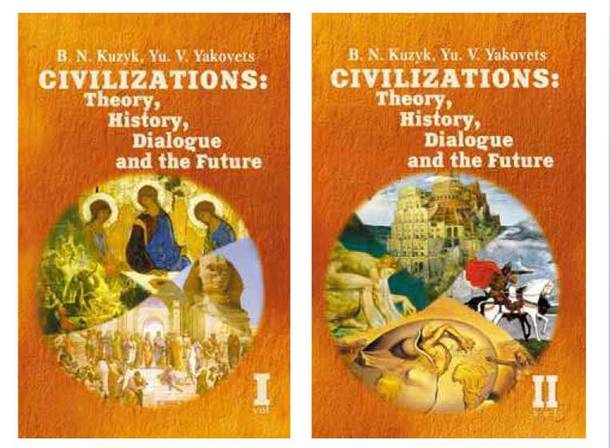
CIVILIZATIONS:
Theory, History, Dialogue and the Future
The issue of civilizations — their past and future, dynamics and interaction — are among the overriding problems of social sciences and socio-political life of the 21st century. The book of known Russian scientists B. N. Kuzyk, Corresponding Member of Russian Academy of Sciences, and Yu.V. Yakovets, Academician of Russian Academy of Natural Sciences, is devoted to these matters.
The reader will find an original treatment of the theory of civilizations, cyclical-genetic regularities of their dynamics, dialogue and interaction, substantiation of historic time compression law. In a civilizational aspect the demographic, natural-ecological, technological, economic, socio-political, spiritual factors of society's development are investigated. The history and the future of civilizations are expounded along three historical super cycles. For the first time the cliometric measurements of the global, world and local civilizational dynamics have been made using a geocivilizational matrix and supplemented by a situation analysis, including a forecast of the place of Russia in a geocivilizational space of the 21st century.
This treatise appeals not only to scientists, post-graduates, students, but also to statesmen, politicians and public figures, to everybody who feels concern for the foredoom of the country and humankind.
Volume I. Theory and History of Civilization
Contents
FOREWORD A Step Forward in Social Sciences A.D. Nekipelov
INTRODUCTION New Century — New Vision of the Past
and the Future
PART I. THEORY OF CIVILIZATIONS
Chapter 1. Emergence and Development of the Theory of Civilizations
■ 1.1. Civilizations: from the Multi-Dimensional Reality to Scientific Categories
■ 1.2. Formation of the Theory of Civilizations 1.3. Theories of Civilizations of the 20th Century 1.4. Contemporary Russian Civilizational Schools 1.5. Essentials of the Theory of Civilizations 1.5.1. Concept and Types of Civilizations 1.5.2. Structure of Civilizations 1.5.3. Evolution of Civilizations in Time 1.5.4. Diffusion of Civilizations in Space
■ 1.5.5. Civilizational Approach to History and Futureof Humanity 1.5.6. Place of the Theory of Civilizations in the System of Sciences
Chapter 2. Civilizational Cycles and Crises
■ 2.1. Regularities in Cyclical Dynamics of Social Systems 2.2. Cycles and Crises in Dynamics of Local Civilizations 2.3. Cyclicity in Dynamics of World Civilizations
■ 2.4. Historical Super Cycles in the Development of the Global Civilization
Chapter 3. Civilizational Sociogenetics
■ 3.1. Sociogenetics as the Cognition Top of Regularities in the Dynamics of Society
■ 3.2. Heredity: Social Genotype of Civilizations 3.3. Variability: Transformation of the Civilization Genotype 3.4. Selection: Mechanism of Development and Change of Civilizations Chapter 4. Dialogue among Civilizations: Theory, Spheres and Institutions
■ 4.1. Content of the Dialogue among Civilizations and Its Place in the System of Their Interaction 4.2. Spheres of Dialogue and Interaction among Local Civilizations
■ 4.3. Institutions for the Dialogue among Civilizations
PART II. TRANSFORMATIONS OF THE CIVILIZATIONAL STRUCTURE
Chapter 5. Natural-Ecological Cycles and Crises in the Evolution of Civilizations
■ 5.1. Natural Factor in Emergence and Evolution of Civilizations 5.2. Spiral of Ecological Cycles and Crises 5.3. Ecological Future of Civilizations 5.4. Ecological Future of Russia 5.5. On the Path to the Noospheric Civilization
Chapter 6. Demographic Basis for Transformation of Civilizations
■ 6.1. Classification of Demographic Cycles 6.2. Historical Trends in Cyclical Dynamics of Population Numbers 6.3. Demographic Challenges of the 21st Century
■ 6.4. Demographic Threats to Russia
Chapter 7. Innovative-Technological Cycles and Crises:
a Civilizational Aspect
■ 7.1. Technologies in the Structure and Dynamics of Civilizations 7.2. Stages of Technological Evolution of Civilizations 7.3. Innovative Waves of the 20th Century
■ 7.4. Innovative Breakthrough to Technological Future of Civilizations
Chapter 8. Cyclicity of Economic Dynamics of Civilizations
■ 8.1. The Gamut of Economic Cycles and Crises 8.2. Economic Cycles and Crises in the Dynamics of Civilizations 8.3. Structural Dynamics of Economy of Civilizations ■ 8.4. Cycles and Crises in the Economy of Civilizations of the 21st Century
■ 8.5. Reproduction and Innovative Renovation Mechanisms of Resources
Chapter 9. Cyclical Dynamics of the Socio-Political System, Revolutions and Warfare
■ 9.1. Civilizational Dynamics of Social Stratification and Mobility 9.2. State-Legal Cycles, Crises and Transformations 9.3. Revolutions in the Civilizational Dynamics
■ 9.4. Warfare in the Structure and Dynamics of Civilizations
Chapter 10. Cyclical Dynamics of the Spiritual Sphere of Civilizations
■ 10.1. Key Role of the Spiritual Sphere in the Structure and Dynamics of Civilizations
■ 10.2. Scientific Revolutions and Crises 10.3. Cyclicity in the Dynamics of Culture
■ 10.4. Educational Cycles and Revolutions in Education 10.5. Dynamics of the System of Civilizational Values
PART III. HISTORY OF CIVILIZATIONS
Chapter 11. Civilizations of the Antiquity
■ 11.1. Preconditions and Factors for the Emergence of Civilizations 11.1.1. Prehistory of Civilizations 11.1.2. The Neolithic Civilizations 11.1.3. Early Class Civilization (the Bronze Age) ■ 11.1.4. The Ancient World Civilization (the Iron Age)
■ 11.2. Dynamics of the Structure of the World Civilizations of Antiquity
■ 11.2.1. Man, Family, Population of Early Societies 11.2.2. Technology and Ecology in the Antiquity 11.2.3. Economy of Early Civilizations 11.2.4. Formation of the Social and Political Structure of Society 11.2.5. Spiritual Life of Early Societies
■ 11.3. Local Civilizations in the Ancient World 11.3.1. Emergence and First Generations of Local Civilizations 11.3.2. Civilizations of the Mediterranean 11.3.3. Early Civilizations of the East 11.3.4. Early Civilizations on the Territory of Westernand Eastern Europe
■ 11.3.5. Civilizations of the Pre-Columbian America 11.4. Dialogue and Interaction among Civilizations of the First Two Generations
Chapter 12. Civilizations of the Second Historic Super Cycle
■ 12.1. World Civilizations of the Second Historic Super Cycle 12.1.1. Medieval Civilization 12.1.2. Early Industrial Civilization 12.1.3. Industrial Civilization 12.2. Dynamics of the Structure of Civilizations of the Second Super Cycle 12.2.1. Growth of Population Numbers, Demands and Abilities of Man 12.2.2. Technological Overturns
■ 12.2.3. Economic Transformations 12.2.4. Evolution of the Socio-Political System
■ 12.2.5. Dynamics of the Spiritual Sphere 12.3. Evolution and Interaction among Civilizations of the Third and the Fourth Generations 12.3.1. Dynamics of Civilizations of the East 12.3.2. Dominance of the Western Civilization 12.3.3. Dialogue and Interaction among Civilizations of the Third and the Fourth Generations
Chapter 13. Civilizational Dynamics on the North of Eurasia
■ 13.1. Rhythms of Civilizational Dynamics in the Region 13.1.1. Neolith 13.1.2. Bronze
Age 13.1.3. Iron Age 13.1.4. Eastern Slavic Civilization 13.1.5. Vladimir-Suzdal Russia and the Muscovy Czardom (Russian Civilization) ■ 13.1.6. Formation of the Northern Eurasian Civilization 13.1.7. The Fate of the Eurasian Civilization in the 21st Century ■ 13.2. North Regions of the Black Sea as Space of Interaction among Local Civilizations 13.2.1. Spaces of Interaction among Civilizations 13.2.2. Waves of Interaction among Civilizations The First Wave of Interaction (7th — 4th c. B.C.) 13.2.3. The
Second Wave of Interaction (3rd c. B.C. — 4th c. A.D.) 13.2.4. The Third Wave of Interaction (6th — 9th c.) 13.2.5. The Fourth Wave of Interaction (10th — 14th c.)
■ 13.2.6. The Fifth Wave of Interaction (15th — 18th c.) 13.2.7. The Sixth Wave of
Interaction (19th — 20th c.) 13.2.8. The Beginning of the Seventh Wave of Interactions
(21st c.) 13.3. Dynamics of the Eurasian Civilization in the Industrial Period
Volume II. Future of Civilizations
and Geocivilizational Measurements
Contents
PART IV. FUTURE OF CIVILIZATIONS
Chapter 1. Outlines of Civilizations of the 21st Century
■ 14.1. At the Outset of a New Historic Super Cycle ■ 14.2. The Essence of the Post-Industrial Civilization ■ 14.3. Transformation of the Structure of Civilizations
■ 14.3.1. Demographic Polarization of the 21st Century ■ 14.3.2 Alternatives of Ecological Future 14.3.3. Coming Technological Overturns 14.3.4. Globalization and Transformation of Economy ■ 14.3.5. Transformations in the Socio-Political and State-Legal Spheres 14.3.6. Formation of Integral Socio-Cultural System 14.4. Outlooks of the Dynamics and Interaction among Local Civilizations of the Fifth Generation
■ 14.4.1 Challenge of Globalization and Response ofCivilizations 14.4.2. Transformation of Local Civilizations of the Fifth Generation 14.4.3. Outlooks of the Dynamics of Local Civilizations in the 21st Century 14.4.4. Scenarios of Interaction among Civilizations in the 21st Century
Chapter 15. Global Civilization: New Challenges
■ 15.1. New Challenges to the Global Civilization in the 21st Century 15.2. On the Path to the World Confederation of States and Civilizations 15.3. Two Views on the Future of the World: Invitation to Discussion 15.4. Future of Civilizations in the Mirror of Future Synergetics 15.4.1. Principles of Futurosynergetics 15.4.2. Evolutionary Space of the 21st Century 15.4.3. The System of Potential Bifurcations of the 21st Century 15.4.4. Criteria of Sustainable Development of Civilizations 15.4.5. Evolution and Interaction of Civilizations 15.4.6. Western Civilization 15.4.7. Eurasian Civilization
■ 15.4.8. Freedom or Necessity?
Chapter 16. Russia in Geocivilizational Space of the 21st Century
■ 16.1. Situation Analysis and Forecast of Geocivilizational Dynamics of Russia
■ 16.2. The Cluster of Critical Situations in Dynamics of Russia by the Beginning of the 21st Century 16.3. The Forecast for Solution of the Cluster of Critical Situations in the 21st Century 16.4. The Russian Science in a Geocivilizational Space of the 21st Century
■ 16.4.1. Crisis of Modern Science 16.4.2. Pessimistic Scenario of the Future of the Russian Science 16.4.3. Optimistic Scenario of the Development of the Russian Science
■ 16.4.4. Place of Russia in the World Scientific Community
PART V. GEOCIVILIZATIONAL MEASUREMENTS
Chapter 17. Cliometric Measurements of Civilizational Dynamics
■ 17.1 Cliometry as a Method of Historic Measurements 17.2. Determination of Intensity of Historical Events in the Dynamics of Civilizations 17.3. Civilizational Dynamics the Mirror in of the Strategic Matrix 17.4. Long and Super Long Waves of Russian History
Chapter 18. Measurement of Civilizational Dynamics: a Geocivilizational Matrix
■ 18.1. Methodology for Measurement of Civilizational Dynamics 18.2. Measurement of Civilizational Dynamics of Europe and North of Eurasia ■ 18.2.1. Dynamics of Population and GDP 18.2.2. Greco-Roman and Byzantine Civilization 18.2.3. Western European Civilization 18.2.4. Eastern European Civilization 18.2.5. Eastern Slavic (Eurasian) Civilization 18.2.6. Summary Estimation of Dynamics of Civilizations
of Europe and North of Eurasia 18.3. Measurements of Dynamics of Civilizations of Asia and Africa ■ 18.3.1. Tendencies in the Dynamics of Population and GDP
■ 18.3.2. Indian Civilization 18.3.3. Chinese Civilization 18.3.4. Japanese Civilization 18.3.5. Buddhist Civilization 18.3.6. Moslem Civilization 18.3.7. Mongolian Civilization 18.3.8. African Civilization 18.3.9. Summary Estimation of Civilizations of Asia and Africa 18.4. Measurement of Civilizational Dynamics of America and Oceania ■ 18.4.1. Tendencies of Dynamics of Civilizations of America and Oceania
■ 18.4.2. Pre-Columbian Civilizations ■ 18.4.3. North American Civilization
■ 18.4.4. Latin American Civilization 18.4.5. Civilizations of Oceania 18.4.6. Summary Estimation of Dynamics of Civilizations of America and Oceania 18.5. Summary Integral Estimation of World Civilizational Dynamics
Chapter 19. Strategic Matrices of Eastern Civilizations Dynamics
■ 19.1. Strategic Matrix of India 19.1.1. India in the Ancient Period (before the 2nd
c. A.D.) 19.1.2. The Middle Ages and Modern History of India (6th — middle of the 19th c.) 19.1.3. The Independence Period (from 1947) 19.1.4. Outlooks of India in the 21st c. 19.2. Strategic Matrix of China 19.2.1. Ancient China 19.2.2. China in the Middle Ages (end of the 6th — beginning of the 17th c.) 19.2.3. Modern History
of China (17th — beginning of the 20th c.) 19.2.4. Contemporary History of China
(from 1949) 19.2.5. Outlooks of China in the 21st c. 19.3. Strategic Matrix of Japan
■ 19.3.1. Ancient Japan (3rd — 7th c.) 19.3.2. Japan in the Middle Ages (7th — the
second half of the 19th c.) ■ 19.3.3. Modern History of Japan (1868-1942)
■ 19.3.4. Contemporary History of Japan (1945-2004) 19.3.5. Outlooks of Japan in
the 21st c. 19.4. Strategic Matrix of Iran 19.4.1. Ancient Persia (558-359 B.C.)
■ 19.4.2. Persia in the Crisis Period of Slave Relations (226-651 A.D.) 19.4.3. Persia
in the Middle Ages (middle of the 7th — beginning of the 10th c.) 19.4.4. Iran under
the Reign of the Mongolian Khans and in the Post-Mongolian Period (13th — 15th cc.)
■ 19.4.5. Persia in the Modern Period (middle of the 16th — end of the 19th c.)
■ 19.4.6. Iran during World Wars I and II 19.4.7. Iran in the Middle and the End of the 20th c. 19.4.8. Outlooks of Iran in the 21st c.
AFTERWORD Rhythms of Civilizational Dynamics.
SUPPLEMENT 1. Resolution Adopted by the General Assembly «Global Agenda for Dialogue among Civilizations».
SUPPLEMENT 2. UNESCO Universal Declaration in Cultural Divertisy
SUPPLEMENT 3. Concept of Sustainable Development and Solution of Global Problems on the Basis of Dialogue and Partnership of Civilizations
SUPPLEMENT 4. World Trade and Fairness: Civilizational Aspect
SUPPLEMENT 5. Six Enigmas of the Minoan Civilization
SUPPLEMENT 6. The First Book on the Theory of Civilizations.
A. Metlinsky. About the Essence of Civilization
Volume III. Northern Black Sea Regions — Space of Interaction among Civilizations
Along with local civilizations there are spaces of their interaction. The most demonstrative example of such space is the northern Black Sea regions — a field of interaction among civilizations and peoples within more than two and a half millennia.
The book for the first time sets forth theoretical foundations and history of development of spaces of interaction among civilizations, deals with basic stages in the development and interaction of civilizations and peoples in the northern Black Sea regions in the Neolithic and Bronze Age, periods of Greek colonization, Roman and Byzantine influence, prevalence of eastern Slavic, Moslem and Eurasian cultures. Actual examples of interaction among civilizations — from dialogue and cooperation to backset and military clashes are provided. An overview of archeological expositions of this period in the museums of Russia and Ukraine is given. The outputs of the scientific-civilizational expedition to the northern Black Sea regions conducted in July 2005 are published. The book unites well a creative scientific search, scientific-historical articles of archeologists and museum workers and emotional itineraries of the expedition members. Exciting pictures of not simple relations between civilizations and cultures within the space of the Nizhny Don and Sea of Azov regions, Taman, Crimea, Southern Pobuzhie, northwestern and northeastern Black Sea regions will open to a reader.
The book is intended for a wide readership — educators and students, teachers and schoolchildren, and scientists, regional ethnographers, tour operators and travelers — for everybody who is interested in the history of civilizations and their interaction.
Contents
FOREWORD (V.I. Gulyaev)
INRODUCTION CHAPTER 1. Spaces of Interaction among Civilizations: Theory and History
■ 1.1. Dynamics of Civilizations in Time and Space ■ 1.1.1. Multidimensionality of Civilizations 1.1.2. Evolvement of Civilizations in Time 1.1.3. Expansion of Civilizations in Space (Geography of Civilizations) ■ 1.2. Spaces of Interaction among Civilizations
■ 1.2.1. Certitude and Essence of Spaces of Interaction among Civilizations 1.2.2. Functions of Spaces of Interaction among Civilizations 1.3. Historical Steps in the Development of Spaces of Interaction among Civilizations 1.3.1. Areas of Interaction among Civilizations of the First Generations 1.3.2. Interaction among Civilizations of the Third Generation
■ 1.3.3. Spaces of Interaction among Civilizations of the Fourth Generation 1.3.4. Prospects for Spaces of Interaction among Civilizations in the 21st century
CHAPTER 2. Preconditions and Beginnings of Civilizational Development in the Northern Black Sea Regions (Neolithic, Eneolithic and Bronze Age)
■ 2.1. Upper Paleolithic and M esolithic in the Northern Black Sea Regions (40-8 millinneia
B.C.) 2.1.1. Geographical Boundaries of the Northern Black Sea Regions 2.1.2. Natural
Demographic and Ecological Cycles 2.1.3. First Steps in the Evolution of Society in the Northern Black Sea Regions 2.1.4. Late Paleolithic 2.1.5. Mesolithic Age 2.2. Neolithic Revolution and Interaction of Tribes in the Northern Black Sea Regions (end of the 6th - beginning of the 5th millennium B.C.) ■ 2.2.1. Neolithic Revolution ■ 2.2.2. Neolithic Revolution and Neolithic Monuments in the Northern Black Sea Regions 2.3. Bronze Age in the Northern Black Sea Regions (end of the 4th - 2nd millennium B.C.) 2.3.1. Theoretical
Findings on the Establishment of Local Civilizations 2.3.2. Eneolithic in the Northern Black Sea Regions 2.3.3. Chronological Frames and Stages of the Bronze Age 2.3.4. NaturalClimate Conditions 2.3.5. Population and Settlement 2.3.6. Instruments of Labor and Bronze Age Technologies ■ 2.3.7. Economic Mode of Production ■ 2.3.8. Leader-based Societies and Wars 2.3.9. Spiritual World of Society in the Bronze Age
CHAPTER 3. Interaction of Civilizations in the Northern Black Sea Regions in the Antiquity (7th c. B.C. - 5th c. A.D.)
■ 3.1. Theoretical Issues of Interaction among Greek Colonies with Local Peoples and Tribes
■ 3.2. The Scythians of the Northern Black Sea Regions in the 7th-6th cc. B.C. (V.I. Gulyaev)
■ 3.2.1. Emergence and Origins of the Scythians 3.2.2. Nomadic Way of Life 3.2.3. Clash of the Scythians with the Persian Civilization 3.2.4. Great Scythia 3.2.5. Relations of the Scythians with Other Tribes and Greek Polies 3.2.6. Scythian Art 3.3. Greek Colonization of the Northern Black Sea Regions (E.M. Alexeyeva) 3.4. Phanagoria: Greek City in the Barbarian Land (V.D. Kuznetsov) 3.5. A Historic Role of Antique States of the Northern Black Sea Regions (D.B. Shelov) 3.6. Great Heritage and Link of Times (Ye.F. Redina)
CHAPTER 4. Interaction among Civilizations of the Third and Fourth Generation in the Northern Black Sea Regions (6th-20th cc.)
■ 4.1. Interaction of Civilizations in the Northern Black Sea Region in the Middle Ages (6th- 16th cc.) ■ 4.1.1. Interaction of Civilizations in the Establishment of the Middle Ages
■ 4.1.2. Russian Kaganate. Tmutarakhan 4.1.3. Influence of the Byzantine Civilization in the Northern Black Sea Regions 4.2. The Golden Horde, Crimean Khanate and Genoese Colonies 4.3. Eurasian and Moslem Civilizations in Struggle for the Northern Black Sea Regions in the Early Industrial Period 4.4. Interaction of Civilizations in the Industrial Period
■ 4.4.1. The Sixth Wave of Interaction Among Civilizations 4.4.2. The Crimean War as the Clash of Civilizations 4.4.3. World War I and Civil Wars 4.4.4. World War II (Great Patriotic War) and the Yalta Conference 4.5. Prospects for Interaction of Civilizations in the Northern Black Sea Regions in the Post Industrial Period
CHAPTER 5. Northern Black Sea Regions in Interaction of Civilizations and Tribes. A View of Archeologists
■ 5.1. The Sea of Azov and Kuban Regions 5.1.1. Between the East and the West: Barbarian and Antique World of the Don and Azov Regions (V.E. Maximenko) 5.1.2. The city of Azov in Interaction among Civilizations (N.M. Fomichev) 5.1.3. Don and Azov Regions in the Ancient Mythology (S.I. Lukiashko) 5.1.4. Historical Past of the Northern-Eastern Azov Regions. Antiquities of the Miussky Peninsula. Taganrog Settlement (A.L. Boiko)
■ 5.1.5. Taganrog - and Northern Sea of Azov Regions Tagangrog Settlement - Cremns on the Maeotian Lake (M.V. Gerasimenko) Scythians and Sarmatians in the Sea of Azov Regions (2nd c. B.C. - 4th c. A.D.) (N.M. Kleopatro) the Sea of Azov Regions in the Golden Horde Period (N.M. Kleopatro) ■ 5.1.6. Greek Poleis - Gorgippia (E.M. Alexeyeva)
■ 5.1.7. Germonassa. Relations of Ancient Traditions and Barbarian (S.I. Finogenova)
■ 5.1.8. Archeological Monuments near Sochi ■ Stone Age; Bronze Age; Iron Age (V.N. Rozov) Middle Ages (V.N. Rozov) Adygs (T.V. Polovinkina) Monuments of the Middle Ages (A.V. Guseva) Annexation of the Black Sea Coast of Caucasus to Russia. 1829-1864 (V.G. Antonyuk) 5.2. From Panticapaeum to Chersonesos 5.2.1. Pantica- paeum - the Capital of the Bosporan Kingdom (V.P. Tolstikov) 5.2.2. Bosporan Cities of the Kerch Peninsula: ■ Porthmion ■ Nymphaion ■ Myrmekion ■ Tyritake ■ Kytaia
■ Acra (O.Yu. Sokolova) 5.2.3. ‘The Mirmekion Treasure' (A.M. Butyakin) 5.2.4. Theodosia — in Antiquity and Middle Ages (Ye. A. Aibabina) 5.2.5. Theodosia Local History Museum (Ye. A. Aibabina) 5.2.6. On the Border of the Hellenic and Barbarian Worlds: Burial of ‘Czarina' in the Nogaichinsk Burial Hill (Yu.P. Zaitsev, V.I. Mordvintseva)
■ 5.3. Chersonesos, Chimbalo and Kerkinitis 5.3.1. Chersonesos - Cherson - Korsun: Monument to Civilization (V.M. Zubar) ■ 5.3.2. Chimbalo (Balaklava) Medieval Fortress (S.B. Adaxina, V.P. Kirilko, V.L. Myts) 5.3.3. Kerkinitis and Western Crimea in the Antiquity (S.B. Lantsov) 5.3.4. Ust-Alminsky Late Scythian Necropolis in the Southwestern Crimea (Yu.P. Zaitsev) 5.4. Cave Cities and Fortresses 5.4.1. Mangup - the Capital of the Principality of Theodoro (A.A. Voloshinov, T.V. Voloshinova) 5.4.2.Sanctuary in the Gurzuf Saddle (N.G. Novichenkova) 5.5. Simferopol and Bahchisarai 5.5.1. Scythian Naples: A View of Archeologist (Yu.P. Zaitsev) 5.5.2. Bahchisarai: Peoples, Centuries
and Traditions (A.A. Voloshinov, T.V. Voloshinova) 5.5.3. Crimean Peoples in the Collections of the Crimean Republican Local History Museum (L.N. Khrapunova) 5.5.4. Tartar Folk Arts in the Dialogue of Cultures (N.M. Akchurina-Muftieva) 5.6. Olbia and Tyras
■ 5.6.1. Pontic Olbia (V.V. Krapivina) ■ 5.6.2. Ancient Tyras: Interaction of the Greek Colony with the Tribes of the Northwestern Black Sea Regions (T.L. Samoilova)
CHAPTER 6. A Scientific-Civilizational Expedition to the Northern Black Sea Regions
■ 6.1. Plan and Aims of the Expedition (A.G. Fedorov) 6.2. In the Low Don Region
■ 6.2.1. Rostov-on-Don, Rostov Local History Museum 6.2.2. Sergey Viktorovich Gurkin 6.2.3. Tanais 6.2.4. The Don Varangians. Aksay 6.2.6. Azov 6.3. Gorgippia, Germonassa and Phanagoria 6.3.1. Anapa 6.3.2. Taman, Tmutarakhan 6.3.3. Phan- agoria: Mecca for Archeologists 6.4. The Bosporan Kingdom: Panticapauem and Theodosia ■ 6.4.1. Crossing ■ 6.4.2. Kerch - Panticapaeum ■ 6.4.3. Theodosia, Kaffa
■ 6.5. Sudak and Yalta. Fortress and Palaces 6.5.1. Passage by Yacht from Theodosia to Sudak 6.5.2. Sudak: The Genoese Fortress 6.5.3. Of the Old Stamp ■ 6.5.4. Night Schumacher 6.5.5. The Yalta Museum 6.5.6. Massandra 6.5.7. The Vorontsov Palace ■ 5.8. Livadia ■ 6.5.9. The Yusupov Palaces in the Crimea (N.V. Glushenkova)
■ 6.5.10. Lastochkino Gnezdo (Swallow's Nest) ■ 6.6. Chersonesos and Sevastopol
■ 6.6.1. Chersonesos 6.6.2. Sevastopol, Panorama 6.7. Cave Cities and Fortresses in the Mountain Crimea 6.7.1. Mangup 6.7.2. Eski-Kermen 6.7.3. Yuri Petrovich Zaitsev 6.8. Scythian Naples and Bahchisarai 6.8.1. Simferopol, Crimean Archeologists
■ 6.8.2. Scythian Naples 6.8.3. Taurida Local History Museum Afterword. Lessons of the Past and Looking into the Future
REFERENCES
Introduction
The book offered for readers does not meet the established literature canons. What is it? A scientific research, a collection of articles of archeologists and museum workers, itineraries of travelers? This is the first, the second and the third — in a three-dimensional space allowing giving a dimensional vision of the exciting, multi-sided subject-matter of this book — a long historical path of the Black Sea regions of Russia and Ukraine as spaces of interaction among local civilizations and natives.
This is a scientific research as ideas expounded in the fundamental writing ‘Civilizations: Theory, History, Dialogue and the Future' (M: INES, 2006) are developed and tested on specific historical materials. Historians, archeologists, civilization researchers will find a number of new points — about territories covered by the first world civilizations (Neolithic, Early Class) not yet reached the level of local civilizations; cultural-historical societies and proto-civilizations as predecessors of local civilizations; forms and mechanism of interaction between tribes, cultural-historical communities, proto-civilizations and local civilizations on spaces of the northern Black Sea regions; Russian Kaganate as one of predecessor of the Eastern Slavic civilization.
But along with it these are itineraries of the scientific-civilizational expedition we arranged in July 2005 to the northern Black Sea regions including information received from the first-string scientists-archeologists, historians and museum workers, and also personal impressions and opinions of the expedition members about the utmost rich history of these areas.
This is also a collection of articles of scientists-archeologists, researchers from the research centers and museums of Russia and Ukraine. The articles address and assess the prime archeological and historical monuments, narrate about new archeological discover-
ies, give views on historical fates of peoples resided in the northern Black Sea regions and contacts between them and neighboring civilizations. Such views incorporate debatable items at times but we did not try to round off rough corners, impose our viewpoint on anybody — the path of cognition is multi-sided and twisty.
What aims did we pursue preparing this writing for publication? Let's be up-front: we've pursued three diverse aims that determined an unusual nature and structure of the book.
First, this is an experimental site for testing ideas, hypotheses, and theories of a relatively new branch of social sciences — civiliography. We pursue this science for many years and dedicated a number of writings to it - on the theory and history of world and local civilizations, varied ways and forms of their interaction enabling to foresee the future of civilizations, their dialogue and partnership, determination of the place of Russia in a geo-civilizational space both in the past and in the prospect for the 21st c. As an attentive reader will see, a number of our hypotheses were corroborated in such experimental test through learning of the utmost rich archeological and historical materials got as a result of the expedition and numerous discussions with specialists.
Second, we want to open to scientists and educationalists, students and schoolchildren the new utmost rich strata of pre-history and history of civilizations, their interaction and dialogue in the south of today's Russia and Ukraine. A human who does not know the depths of the history of his country, ways of the establishment of his nation, its contacts with other nations, treating with neglect or hostility other civilizations can't be a national and a patriot. In the resolution ‘Global Agenda for Dialogue among Civilizations' the UN has called upon studying the history of constructive interaction among civilizations, foster the development of dialogue among them. Contemporary and future generations should know historical roots, rich experience of communications of their own and other civilizations, to learn to respect such experience, and use it in actual practice. This is the right remedy to prevent clashes among civilizations, curb international terrorism. We hope that this book equally with the writing referred to above will take a worthy place in the educational process. We've translated this monograph into English for such purpose and place on the Internet, deliver presentations in Russian and abroad.
Third, the book has a practical aim — to foster the development of civilizational, cultural-historical tourism in this region, turn it into the utmost interesting regions, route for travelers, one of the world's centers for international and national tourism. Indeed, where else one can find such concentration of the utmost rich cultural-historical monuments under favorable climate conditions as in the resort cities, areas of archeological sites, cave cities of the Sea of Azov regions and northern Black Sea regions? We are sure that the book will gain attention of travel agencies and tour operators that millions of travelers from various countries will desire to make an exciting trip across the spaces of dialogue and interaction among civilizations.
Time and unbiased judgment of readers will show to what extent we were successful in the achieving such aims.
The book which is the third volume of a multiple volume edition “Civilizations: Theory, History, Dialogue, and the Future” makes a logical continuation of the first two volumes appeared in 2006, a kind of an experimental field for testing ideas and concepts published in such writings. Volume IV “Origins and Highlights of the Eastern Slavic Civilizations” pending publication pursues the same goal.
The authors express their sincere gratitude to all who participated in mounting the expedition and preparing this book for publication and first of all to all self-giving and dedicated breed of archeologists, historians and museum workers who open, store and transmit nobly to the next generations the invaluable historical and cultural heritage of civi
lizations contributing a lot to their dialogue and development. A large work performed by Dr. Sc. (History) V.I. Gulyaev pertaining to scientific editing of the book, making a foreword to one of its chapters deserves a special mention as well as the efforts of Dr. Sc. (History) Yu.P. Zaitsev to collection and editing materials devoted to the Crimea, Olbia, Tyras, and Odessa. We are grateful to S.V. Gurkin, now deceased for assistance in mounting the expedition to the Rostov Oblast and Krasnodar Krai, to all expedition members who input their labor and enthusiasm in its holding and familiarizing with cultural-historical monuments of the northern Black Sea regions, G.A. Fedorov for an exciting diary of the expedition, and also O.P. Bardova, employees of the publishing office and T.V. Shvetsova who put a lot of efforts so that the book be ready for appearing and its publishing.
Prof. B.N. Kuzyk- R.A.S. Corresponding Member,
Director of the Institute for Economic Strategies
Prof. Yu.V. Yakovets- R.A.N.S. Academician, President
of the Pitirim Sorokin - Nikolai Kondratieff International Institute
Afterword
Lessons of the Past and Looking into the Future
Thus, we've walked together with a reader a long and not easy path in a three-dimensional space. Across the territory of several thousand kilometers along the coast of the Black Sea and the Sea of Azov — from Tanais and Sochi to Olbia and Tyras. In time — for the whole historical period of the establishment and development of world and local civilizations in this region. Through the areas of interaction among various civilizations and Scythian proto-civilization in the 7th-6th cc. B.C. before the clashes and dialogue of the Eurasian, Western European and Moslem civilization in the 20th century. What does such path teach us? What are historical lessons of interaction among civilizations in the northern Black Sea regions and what should we expect in future?
The first lesson. Local civilizations are not separated from each other by the Chinese Wall. Their boundaries are nominal, ongoing contacts exist in this or that form — from dialogue and partnership to confrontation and armed conflicts — with other civilizations and peoples. Therefore the spaces of interaction and interpenetration of civilizations arise as a matter-of-course. Such spaces are changeable, they are dynamical, and an ongoing change of characters and forms of interaction is typical of them. All historical way of the northern Black Sea regions is full of such changes, interaction only remains constant.
The second lesson. The results of interaction among civilizations are multi-valued. If it develops under relatively peaceful conditions and active economic and cultural exchange, it contributes to a civilizational progress of all parties involved in such interaction. If a wave of clashes and wars sweep, civilizations incur heavy losses and are thrown back for a long time. Although historians traditionally pay greater attention to the clashes and destructive wars, the trend of civilizational progress based on dialogue and exchange between civilizations prevails in practice.
The third lesson. They usually begin the history of the eastern Slavic civilization from the second half of the 1st millennium B.C., from Kievan Rus. The history of Greek polies from the 7th-6th cc. B.C. and their interaction with local tribes, peoples and protocivilizations remains overside, apart. It is generally assumed that the wave of the Hun invasion swept across the Great Steppe destroyed the heritage of more than a millennium historical way to the foundations. But our researches and contacts have shown that it is not so. It is likely that the first act of the great historical drama in the fate of our civilization began from the Greek-Scythian interactions extending the retrospect of such drama for more than a millennium back. The prehistory of a long civilizational way should be moved several millennia back more, to the Neolithic revolution period in this area. Representatives of the vanguard Greek civilizations who settled on the coasts of the Black Sea met not the savages who were at the pre-civilizaitonal development stage but with the tribes, leader-based states and proto-civilizations passed the Neolithic and Eneolithic stages and who were at the stage of the Bronze or Early Iron Age although they did not reach those heights in the development of technology, economy and political organization as the Greek polies and calling others barbarians.
The fourth lesson. It is exactly intensity and diversity of civilizational contacts throughout more than two and a half millennia under a regular change of characters created a unique and utmost reach by its content world museum of interaction among civilizations in the northern Black Sea regions which expanded to the thousands of kilometers and hundreds of cultural-historical centers and utmost valuable archeological monuments. Neither other peoples and civilizations nor peoples residing here, their political, business and scientific elite realize it to a full extent yet. The real wealth lies without attention, uncalled and often ruining, disappearing without leaving a trace. Our generation has to answer to the coming generations for that.
The fifth lesson and findings for the future. While it is not late we should treat such heritage as judicious masters. What does it mean in actual fact?
• To understand and really evaluate from the positions of a civilizational approach to history and future the structure and value of historical heritage of the northern Black Sea regions, lessons of interaction among civilizations on its space, world-historical value of experience accumulated here and its significance for the pursuance of the global strategy of dialogue and partnership among civilizations in solving burning problems of the 21st century. This is an objective of a new branch of science — civiliography uniting knowledge and efforts of archeologists and historians, sociologists and economists, politologists and culturologists.
• To make new knowledge received available to the public, include in the system of education (both high and higher and post-graduate and distance learning) inuring to the multi-dimensional vision of the world since childhood, understanding diversity of civilizations and respect of own and other civilizational values, upbringing to tolerance and dialogue. This is the best prevention of terrorism, racism and xenophobia. This is a matter of educationalists of all forms of education, all links of education in various civilizations. The lessons of the northern Black Sea regions are quite to the point.
• One can't do with education only — this is a long process, and a series of conflicts between civilizations is increasing from year to year aided by a strengthening migration. Mass media, telecommunication channels influence more and more to understanding of the world and psychological patterns, and they are extremely commercialized now, oversaturated with the scenes of cruelty and enmity, nurture a sense of loneliness and lack of prospects in the world running wild with readers and viewers, become a growth medium for terrorism, civilizational and religious fanaticism, and xenophobia. Many workers of such sphere have forgotten about their responsibility to the past and future generations,
educational programs and pages bringing to kindness and tolerance, love to people and nature are thrown away or ousted to the edge. It is time for representatives of information sphere to remember about the responsibility and actively apply constructive examples of dialogue and interaction among civilizations in the northern Black Sea regions and other regions for a striking and exciting sharing of positive experience.
• They say not without reason that it is better to see once that to hear a hundred time, to make sure with one's own eyes in the richness of historical-cultural heritage, fruitfulness of dialogue among civilizations and destructive force of their clash. Civilizational tourism — not only international but national which is especially valuable for oncoming generations — contributes to it the best. The northern Black Sea regions are an ideal place for development of civilizational tourism. It is not only an exciting affair but a quite efficient and profitable sector. It is able to raise economy and culture of this region, ensure the employment of tens of thousands of specialists and enthusiasts, contribute to filling the sources for saving the world cultural-historical heritage leave alone the millions of tourists who may holiday and build up health in this region which once attracted here the Greeks and Romans spoilt by a subtropical climate. This should be understood and the problem should be tackled with all energy not only by tour operators, educationalists, archeologists, historians but businessmen, central and local authorities. The development of civilizational tourism in this region will require a lot of investments although not that large as it might seem if the course is charted toward cruise tourism and use the resort facilities left after the USSR to maximum which is poorly occupied now and therefore becomes more and more expensive. These investments will pay for a thousandfold if business is arranged properly that is indicated by up-to-date figures for other countries. In 2007, Russia generated USD 7.4 bln. only from international tourism (and spent 18.8 bln. for outbound tourism), Ukraine — 3 bln., while Germany — 38.4 bln., Austria — 19.3; Italy — 38.3; Spain — 53; UK — 39.6 bln, and not that rich in historical monuments USA — USD 129.9 bln. that is 17 times more than Russia and 35 times more than Ukraine.
New prospects in the opening up of the northern Black Sea Regions are expected in connection with construction of the largest international and tourist center near Sochi. The development of tourism only may pay for large-scale investment in such construction. A wide area for efficient strategic partnership between Russia and Ukraine is opening in the establishment of world's largest international tourist centers on the spaces of dialogue and interaction of civilizations.
The sixth lesson. The northern Black Sea regions is not the only but exclusive for the north of Eurasia space of dialogue among civilizations. Northwestern Rus, Great Volga and Neva-Baltic Roads — thoroughfares of interaction among civilizations, Great Steppe where the waves of population shifts swept, Great Silk Road and other could be mentioned. These spaces may also become the subject-matter of intensive historical-civilizational expeditions, centers of civilizational tourism. What we've done and addressed in this book — only the beginning of the path. We rely on a worthy continuation, extended reproduction of ideas, undertakings and successes.
Boris N. Kuzyk
Boris N. Kuzyk, Director of the Institute for Economic Strategies (Moscow), is a Professor, Doctor of Economic Sciences and a Correspon-ding Member of Russian Academy of Sciences. He is also a Honoured Scientist of Russian Federation and a winner of Natio-nal prize in the field of Science and Technology.
Mr. Kuzyk is a well-known researcher both in Russian scientific community and abroad in the field of economic theory, theoretic problems of Russian high-tech industry, rental relations, theory of management in economic and innovation spheres in Russia.
Boris Kuzyk is the author of more than 20 books. Among them «High-Tech Complex in Russian Economy», «The Choice of the Century», «The Rhythms of Russian History», «Russia Has the Only One Effective Way of Development — its Own One», «Russia and the World in 21st Century».
Yury V. Yakovets
Yury V. Yakovets is a Dr. Sc. (Economics), Professor of the Russian Academy of Public Administration under the President of the Russian Federation, Chairman of the Branch of Cycles Research and Forecasting of the Russian Academy of Natural Sciences, President of Pitirim Sorokin — Nikolai Kondratieff International Institute. He is an Honored scientist of the Russian Federation.
In the past he headed a department at the Leningrad Mining Institute, was a Director of the Scientific-Research Institute on Pricing, headed a Department at the Academy of the National Economy under the Government of the Russian Federation, was a VicePresident of the Russian Financial Corporation.
Yu. V. Yakovets is a prominent scientist in the field of social sciences, he is a head of the modern school of the Russian cyclicism. He is an author of more than 620 published works, including 30 monographs.
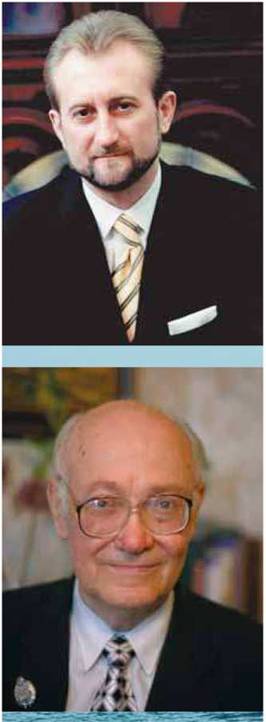
Кузык Борис Николаевич Яковец Юрий Владимирович
Еще по теме ЦИВИЛИЗАЦИИ: теория, история, диалог, будущее:
- Глава 4 ДИАЛОГ ЦИВИЛИЗАЦИЙ
- Г лава 15 ГЛОБАЛЬНАЯ ЦИВИЛИЗАЦИЯ: НОВЫЕ ВЫЗОВЫ
- Г лава 18 ИЗМЕРЕНИЯ ДИНАМИКИ ЦИВИЛИЗАЦИЙ: ГЕОЦИВИЛИЗАЦИОННАЯ МАТРИЦА
- Институты диалога цивилизаций
- Содержание диалога цивилизаций и его место в системе цивилизационных взаимодействий
- Цивилизации: теория, история, диалог, будущее / Б.Н. Кузык, Ю.В. Яковец; Авт. вступ. ст. А.Д. Некипелов. — М.: Институт экономических стратегий. Т. III: Северное Причерноморье — пространство взаимодействия цивилизаций / Б.Н. Кузык, Ю.В. Яковец; Науч. ред., авт. предисл. В.И. Гуляев. — М.: Институт экономических стратегий,2008. — 908 с., 2008
- Цивилизации: теория, история, диалог, будущее. Т. V: Цивилизации: прошлое и будущее: Учебник / Б.Н. Кузык, Ю.В. Яковец; авт. слова к читателю В.М. Филиппов. — М.: Институт экономических стратегий,2008. — 576 с., 2008
- 2.3.4. Инновационная цивилизация
- «Скрепы» цивилизации
- Цивилизации: теория, история, диалог, будущее: В 2 т. Т. I: Теория и история цивилизаций.. / Б. Н. Кузык, Ю. В. Яковец; Авт. вступ. ст. А. Д. Некипелов. — М.: Институт экономических стратегий, 2006— 768 с., 2006