Jean-Claude Gardin THE ARCHAEOLOGICAL EXPLORATION OF EASTERN BACTRIA (AFGHANISTAN): ITS CONTRIBUTION TO THE HISTORY OF EARLY ECONOMIC AND POLITICAL DEVELOPMENTS IN CENTRAL ASIA
The archaeological expeditions conducted in Central Asia have brought radical changes in the history of that part of the world, hitherto based for the most part on ancient written sources.
The older periods in particular—prehistorical and protohis- torical—were poorly represented in those sources, in contrast with the wealth of information provided by the innumerable surveys and excavations carried out during the past decades in the vast territory extending from the Caspian sea to the Pamir mountains. The purpose of the present paper is to add a few more facts and ideas concerning the early economic and political development of ancient Bactria, following the exploration of the south-eastern part of that region by a French mission in the last years of its cooperation with the Afghan Institute of Archaeology.The area studied is very small, compared to the territory referred to as Central Asia in the archaeological literature (fig. 1). Moreover, our field-work there has been rather limited: a surface survey interrupted by political circumstances after five seasons (Gardin & Lyonnet 1978-79), and a few soundings only one of which led to a proper excavation, near the modem village of Shortughai’ (Francfort 1989). Yet, the data collected raise interesting questions regarding the history of Central Asia in ancient times, from the Chalcolithic period to Alexander’s conquest.
1. Economic developments
A major discovery has been the existence of impressive irrigation systems dating back to the Bronze and Early Iron ages, long before the Persian and Greek conquests of Central Asia (fig. 2). The basis for those chronological attributions has been exposed in a preliminary report (Gardin & Lyonnet 1978-79: 129-137) and more fully discussed in the final ceramological publication (Lyonnet 1997: 57-118). The technical skills implied by the digging of those ancient canals were brought out in the same report and more amply illustrated in later publications (Gardin 1980, Gentelle 1989:
© J.-Cl.Gardin, 2001
83-105).
I shall concentrate here on a few lessons drawn from those observations, some in the form of open questions, others as firmer hypotheses regarding the course of economic progress in Bactria prior to its inclusion in the Achaemenid empire.1.1 The first question concerns the circumstances that led to the apparently sudden emergence of complex irrigation systems in our area, towards the middle of the 3rd millennium. Our survey failed to reveal any trace of artificial irrigation in earlier times. On the other hand, the most ancient pottery collected on sites clearly dependent upon irrigation was of Harappan origin. This diagnosis was confirmed by the excavations at Shortugha’i: the Harappan settlement rests on virgin soil, crossed by the “complex” canal postulated in the course of the survey (Francfort 1989: 57-8). The straightforward interpretation of those observations consists in forming the hypothesis of a “colonization” of our region by Harappan settlers bringing with them the knowledge of sophisticated irrigation techniques developed in the Indus valley. Further, should we wish to “explain” that migration from India to Central Asia in the mid-3rd millennium, the lapis lazuli trade would immediately come to mind, given the relative proximity of the mines in Badakhshan; and indeed the excavations of Shortugha’i did reveal workshops of that precious stone in the Harappan level (ibid., pp. 174, etc.).
However, this scenario is only part of the picture. Artificial irrigation was practised in other regions of Central Asia before the Harappan expansion—for instance in the Zarafshan valley, a few hundred kilometers to the North (Besenval 1989: 18), not to speak of more distant Turkmenia (Lisicina 1978). We should not therefore exclude the possibility of earlier developments of that technology in Bactria itself, under the pressure of ecological factors. An hypothesis of that sort seems to follow from the model proposed by several authors regarding the progress of agriculture in Central Asia.
Sedentary communities depending upon dry farming and cattle raising probably settled first in the- hilly areas where wood, grass and water were readily available (Nikonov & Ranov 1973, Vallino & Marinucci 1989, Sarianidi 1992: 124-5). In the course of time, the phenomenon described as “desertisation” (different from desertification) would have taken place, “the consequence of both (being) an arid climate and human activities in fragile ecosystems” (Le Houerou 1979: 336). Deforestation, overgrazing and the resulting degradation of the soil would eventually lead to a search for a more favourable environment in the lower plains watered by seasonal streams or permanent rivers. F. Vallino and C. Marinucci imagined an evolution of that sort in Eastern Bactria on the basis of data found in the archaeological literature (1989: 178, 183-6, 193-6); and a similar process has since been observed in other parts of Central Asia—Margiana (Hiebert 1994b: 175), Turkmenia (Masson 1992: 225-9). The digging of canals would then seem to be a likely outcome, suggested by the natural gullies on the foothills or the channels cut in the lower terraces of meandering rivers.1.2 Doubts are thus permitted regarding the circumstances that led to the emergence of artificial irrigation in Eastern Bactria; but the archaeological evidence from this region establishes at least its more or less continuous growth through the Late Bronze and Early Iron ages, long before the Achaemenid empire had extended its sway over Central Asia. The chronology based on our surface sherds is a very crude one, which does not enable us to follow the details of that process (Gardin 1997: §2.3). Thus, the period just mentioned covers many centuries, from the middle of the 2nd millenium to the Persian conquest, during which the history of irrigation in our
region is likely to have gone through ups and downs that elude us. One thing is however certain: additional programs of a considerable scope had been undertaken or were under way in Eastern Bactria when Cyrus fought his campaigns in the area.
I shall examine further on the consequences of that finding on our vision of the political situation a Central Asia before its inclusion in the Persian empire {infra, §3.2). Meanwhile, let us remain in the field of economy and ask another question: what were the possible motives for such a spectacular growth of artificial irrigation in Eastern Bactria from the Bronze age to the middle of the 1st millennium B.C. ?First, what do we mean by the word “spectacular”? The additional canals attributed to that period, after the initial works of the late 3rd millennium, had to be dug through rugged ground, or across hilly slopes subject to periodic erosion in the rainy sesons, and over relatively long distances in order to reach by gravity alone the terraces or plateaux which they were meant to water. Moreover, the surfaces conquered in this way for irrigated agriculture were rather limited, hardly matching the amount of time and effort invested in such programs. Examples are given in fig. 3; the most impressive one is the Rud-i Shahrawan project. It implied the design of a derivation of the Taluqan river towards the Amu Darya, some fifty kilometers away to the North, from which acrobatic canals were to be drawn in order to bring water to a few narrow stretches of land untouched by previous irrigation works, in the* Hazar Bagh and Archi areas. Why should it be necessary to expand the acreage of irrigated agriculture at this cost? Another way to state the problem is to bring out the quantitative phenomenon known in economics as the trend toward decreasing marginal returns, observable in Eastern Bactria over the 2nd and 1st millennium; I have demonstrated it—or so I think—in my forthcoming book through various computations that need not be repeated here (1997: §7.4.1, E). The problem is to identify the forces active behind that trend.
A common solution in such cases is to call in “demographic pressure”; but we have no way to prove or disprove it here. Besides, the number and size of the sites attributed to pre-Achaemenid times in our survey suggest nothing of the kind.
An alternative explanation is that more food was needed, even at increasing costs, to meet the demands of an economy based on various forms of tribute (internal or external), as well as on the free exchange of goods with other parts of Central Asia. My own view, I am afraid, is rather a retreat from those scenarios: our survey does not offer us enough data to answer the question unambiguously. An important fact has none the less been established regarding the degree of agricultural progress reached or planned in Eastern Bactria in the period which preceded the Achaemenid conquest, as well as the continuation of that progress in later times under Persian and Greek rulers. This last proposition is based on the following observation: the digging up of the Rud-i Shahrawan was probably undertaken at the turn of the 2nd and 1st millennia, judging from the pottery collected all along its course between Toregh and Hazar Bagh; but the narrow streches of land irrigated by the foothill canals drawn from the Rud-i Shahrawan yielded only Greek sherds (not to mention the early Islamic pottery of later times). The implication seems to be that this long-range program was continued or at least kept in mind while Eastern Bactria was under satrapic authority, to be completed only later, in Greek times. The part played by foreign conquerors in this case may in fact have been relatively minor; for their interest would be to leave matters of irrigation in Bactrian hands whose age-long expertise in that domain could hardly be rivalled. This hypothesis finds some support in other inferences drawn from our survey regarding the political evolution of Eastern Bactria in the same time range—my next topic.
2. Political developments
2.1 The political implications of artificial irrigation have been abundantly discussed in the archaeological literature. The core of the argument, under many different forms, lies in establishing a logical relation between the complexity of irrigation systems and the kind of socio-political organization required for their design and use in a given community.
An extreme version of that view is the well-known thesis presented in its time by Wittfogel, according to which the development of large-scale irrigation works in the semi-arid context of the Near East was necessarily linked to the emergence of the State. Ambiguities remain, however, as to the meaning of that last word. Observations drawn from archaeology and ethnology suggest that advanced forms of water management are possible under a variety of socio-political regimes, that do not all agree with the usual definitions of the State (Earle 1991). “Hydraulic communities” are known throughout the world where the digging and upkeep of complex irrigation systems take place under the authority of local rulers whose powers are otherwise limited, in substance as well as in space, well short of the scope of a centralized state. Examples can be found at different periods in Asia, from Syria (Braemer 1988) to Bali (Lansing & Kremer 1993) through Nepal (Aubriot 1995) and Central Asia itself (Mukhamedzhanov 1994: 290). Yet, the dominant view among archaeologists is that the Bronze age communities found in Turkmenia, Mar- giana and Bactria had reached in the 3rd or 2nd millennium a degree of sociopolitical organization that falls within the compass of the state or protostate concept. Has our survey anything to say on that point?The irrigation map of Eastern Bactria in the second half of the 3rd millennium (fig. 2) is somewhat inconclusive in this respect, for the reasons just recalled. The technical sophistication of the major canals of that time certainly justifies the view that the communities responsible for their planning and management were “complex societies”—a popular notion in the archaeological literature of the last decades. Its meaning varies from one author to another; but we would at least agree that the kind of “complex” political organization involved does not necessarily include all the features currently associated with the state concept. A plausible scenario, for instance, would stage autonomous chiefdoms or peer polities (Renfrew & Cherry 1986), each exerting its authority over one of the distinct geographical areas shown on fig. 2, equiped with its own irrigation system—the lower Kokcha basin, the plain of Taluqan, the Kunduz region. Some relationships would have existed between them, surely, given their proximity and, most likely, their common culture; but such relationships need not be conceived solely on a vertical model, with one “centre” of power dominating the others, wherever we chose to locate it—within the limits of our survey (e.g. at Kunduz, see below) or elsewhere (Western Bactria, Margiana?).
The picture changes, however, as we turn to the next map showing the progress of irrigation in the following period—roughly, the Iron age, till the end of the 1st millennium B.C. (fig. 3). I mentioned above the Rud-i Shahrawan project and its amazing history; one of its obvious features is its inter-regional scope. A unique centre of planning and decision was needed to secure the cooperation of landlords from different regions hitherto regarded as possibly autonomous, under local chiefs. A step had thus been taken towards the establishment of a higher level of authority over Eastern Bactria (or at least a large part of it) long before the Persian conquest.
Can we go further and suggest a plausible location for the seat of this authority? Within the limits of our survey, the Bala Hissar of Kunduz would be the most likely answer (fig. 2). Not only is it the largest site where pre-Persian sherds were found on the surface—contra previous datings in the Kushan period (bibliography in Fisher 1969: 349)—but its geographical position in the largest and most central irrigable plain of Eastern Bactria makes it a suitable candidate as a focal point in that area. However, this hypothesis needs to be qualified, for there is no reason to isolate the region under study from the rest of Central Asia in those times. On the basis of ceramic finds, a certain “unity” of Central Asia in the centuries that preceded the Persian conquest has been postulated more than once in the past decades, from the Caspian sea to the Pamir mountains. Doubts remain, admittedly, as to the precise nature of that unity in political terms; and we cannot exclude the hypothesis of a state or state-like organization established over Central Asia in the early part of the 1st millennium B.C., of which Eastern Bactria would be a part. The Kunduz “capital” suggested above would then have to be regarded as “peripheral” within that higher political entity, wherever we chose to place its “centre” (Algaze 1993; 322).
2.2 The same status could be assigned to Eastern Bactria as a whole, back in the Bronze age; for its achievements in irrigated agriculture do not seem to be accompanied by the urbanization process observed elsewhere in Central Asia during that period. Most of the Bronze age sites in our survey are rural settlements of a modest size, which do not bear comparison with the contemporary proto-urban centres excavated in Western Bactria or Margiana. A major feature of the so-called Bactrian- Margiana Archaeological Complex (Sarianidi 1987, Hiebert 1994a, b)—or more briefly the Oxus civilization (Francfort 1989: 401, 409)—is precisely the emergence of large built-up areas with elaborate monuments described as “palaces” or “temples” (Francfort 1994), which have no counterparts in Eastern Bactria. Some of them, surrounded by walls, suggest defensive functions as well. Our survey has indeed revealed a dozen fortified sites dating back to pre-Hellenistic times (Gardin 1995); but none of them can be attributed with confidence to the Bronze age (ibid., pp. 97, 99). It does therefore look as if Eastern Bactria kept out of the urban or proto-urban developments that took place further West in the Oxus basin at the turn of the 3rd and 2nd millennium.
Our datings in the following period are more secure: fortified sites multiply in Eastern Bactria during the Iron age, repeating a pattern that has been amply documented elsewhere in Central Asia (Askarov 1992: 451-3, Francfort 1994: 276-8). This phenomenon was formerly associated with the Achaemenid conquest of Bactria: the argument was that strongholds were built on the Eastern frontier of the Persian empire to protect it against the raids of “nomads” from the Eurasian steppes. Higher dates are now proposed, in the early part of the 1st millennium B.C. (Francfort 1994: 277, Zadneprovskij 1995: 157), that run counter to that interpretation; our own chronological attributions of prehellenistic fortified sites in Eastern Bactria—or at least some of them—point in the same direction.
Should we conclude that the urbanization process in our “peripheral” region had now caught up with its general course in Central Asia? The only relevant information provided by our survey on this matter is the size of our tentative “cities”, within their fortified walls: three of them are close to 20 ha, while the remainder varies between 1 and 10 ha. A similar separation between “large” and “small” fortified sites has been traced by other authors in the same period (Askarov 1992: 451, Francfort
1994: 227); only the large ones are said to quality as proto-urban, but some of them cover a much wider area than our walled “cities” (up to 70 ha). This disparity could be taken to indicate that Eastern Bactria retained under the Persians the “peripheral” status which we attributed to it in the Oxus civilization of earlier times. We should however keep in mind that its position in this respect changed radically under the Greeks, when Аї Khanum became one of the major political and economic metropolises of Central Asia—a useful reminder to bar deterministic interpretations of the kind of developmental differences expounded in this paper.
REFERENCES
Algaze, G. “Expansionary Dynamics of Some Early Pristine States”. American Anthropologist 95, 2 (1993):304-333.
Askarov, A. “The Beginning of the Iron Age in Transoxiana”. In Dani, Masson, eds.:441- 458.
Aubriot, O. “La clepsydre: de l’astrologie a l’hydraulique. Exemples d’emprunt dun syst£me de distribution de l’eau d’irrigation au N£pal”. Annates de la Fondation Fyssen 10 (1995):33-42.
Braemer, F. “Prospections arch^ologiques dans le Hawran. II, les r£seaux de l’eau”. Syria LXV, 1-2 (1988):99-137.
Dani, A.H., Masson, V.M., eds. History of Civilizations of Central Asia, vol. 1: The Dawn of Civilization: Earliest Times to 7000 B.C. Paris: UNESCO Publishing House, 1992.
Earle, T., ed. Chiefdoms: Power, Economy and Ideology. New York: Cambridge University Press, 1991.
Fischer, K. “Preliminary Remarks on an Archaeological Survey in Afghanistan”. Zentralasi- atische Studien 3 (1969):327-408.
Francfort, H.-P. Fouilles de Shortugai. Recherches sur TAsie centrale protohistorique, vol. 2. Paris: Diffusion De Boccard, 1989.
Gardin, J.C. “L’arch£ologie du paysage bactrien”. Comptes Rendus de TAcademie des Inscriptions et Belles-Lettres (1980):480-501.
____ . “Fortified Sites of Eastern Bactria (Afghanistan) in Prehellenistic Times”. In Invemizzi, ed. In the Land of the Cryphons. Firenze: Le Lettere, 1995, 83-10.
____ . Prospections archeologiques en Bactriane orientate (1974-1978), vol. 3: Description des sites et notes de synth£se. Paris: Editions Recherches sur les Civilisations (in print).
Gardin, J.-C., Lyonnet, B. “La prospection archdologique de la Bactriane orientale (1974- 1978): premiers r£sultats”. Mesopotamia XIII-XIV (1978-79):99-154, pl. I-IX.
Gentelle, P. Prospections archdologiques en Bactriane orientale (1974-1978), sous la direction de J.-C. Gardin, vol. 1: Donndes paldographiques et fondements de Tirrigation (avec la collaboration de C. Marinucci, F.O. Vallino, J. Trichet). Paris: Diffusion De Boccard, . 1989.
Hiebert, F.T. “Origins of the Bronze Age Civilization in Central Asia”. American School of Prehistoric Research, Bull. 42. Cambridge (Mass.): Peabody Museum of Archaeology and Ethnology, Harvard University, 1994.
____ . “Production Evidence for the Origin of the Oxus Civilization”. Antiquity 68 (1994):372-387.
.Lansing, J.S., Kremer, J.N. “Emergent Properties of Balinese Water Temple Networks: Coadaptation on a Rugged Fitness Landscape”. American Anthropologist 95, 1 (1993):97— 114.
Le Houerou, H.-N. “La d£sertation des regions arides”. La Recherche 99 (avril 1979):336- 344.
Lisicina, G.N. Stanovlenie і razvitie oroshaemogo zemledelija v Turkmenii. Moscow, 1978.
Lyonnet, B. Prospections archdologiques en Bactriane orientate (1974-1978), sous la direction de J.-C. Gardin, vol. 2: Cdramique et peuplement du Chalcolithique a la conqudte arabe. Paris: Editions Recherche sur les Civilisations, 1997.
Masson, V.M. “The Bronze Age in Khorasan and Transoxiana”. In Dani, Masson, eds., 1992:225-245.
Mukhamedzhanov, A.R. “Economy and Social System in Central Asia in the Kushan Age”. In Harmatta, J., Puri, B.N., Etemadi, G.F., eds. History of Civilizations in Central Asia, vol. 2: The Development of Sedentary and Nomadic Civilizations, 700 B.C. to A.D. 250. Paris: UNESCO Publishing House, 1994:256-290.
____ . Istorija oroshenija Bukharskogo oazisa. Moscow: FAN, 1978.
Nikonov, A.A., Ranov, V.A. “Novye dannye ob arkheologii kamennogo veka і vozraste rechnykh terras Afgano-tadzhikskoj depressii (Sevemyj Afganistan, Juzhnyj Tadzhikistan)”. Bjulleten’ Komissiipo izucheniju chetvertichnogo perioda 40 (1973):35-51.
Renfrew, C., Cherry, J.F., eds. Peer Polity Interaction and Sociopolitical Change. New York: Cambridge University Press, 1986.
Salvatori, S. “Protohistoric Margiana: On a Recent Contribution” (review of IASCCA Information Bulletin 19, Moscow, 1993). Rivista di Archeologia XIX (1995):38-55.
Sarianidi, V.I. “Food-producing and Other Neolithic Communities in Khorasan and Tran- soxiana: Eastern Iran, Soviet Central Asia and Afghanistan”. In Dani, Masson, eds., 1992:109-126.
____ . “South-west Asia: Migrations, the Aryans and Zoroastrians”. IASCCA Information Bulletin 13 (1987):44-56
Vallino, F., Marinucci, C. “Essai de reconstitution du paysage bactrien et de son £cody- namique”. In Gentelle, 1989:161-206.
Zadneprovsky, Y.A. “Early Urban Developments in Central Asia”. Iran XXXIII (1995): 155- 159.
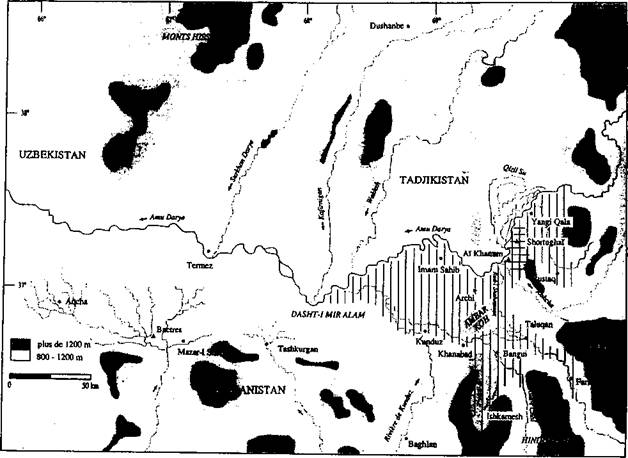
Fig. 1
The area covered by the Franco-Afghan survey in Eastern Bactria (1974-78)
Fig. 2
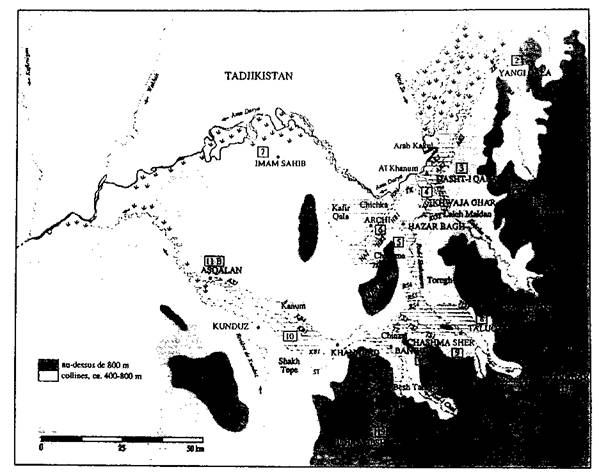
Settlement areas in the Bronze age, the larger ones in the low plains (zones 3, 6, 8, 11B), others in the mountainous zones (15 to 18). Artificial irrigation developed in the former, with sizeable canals (probable courses marked in dotted lines); no Bronze age sites have been found in the Kunduz plain, but the irrigation of the narrow terrace in the Asqalan area (zone 1 IB) hints at a probable occupation of the lower plain as well (zone 10)
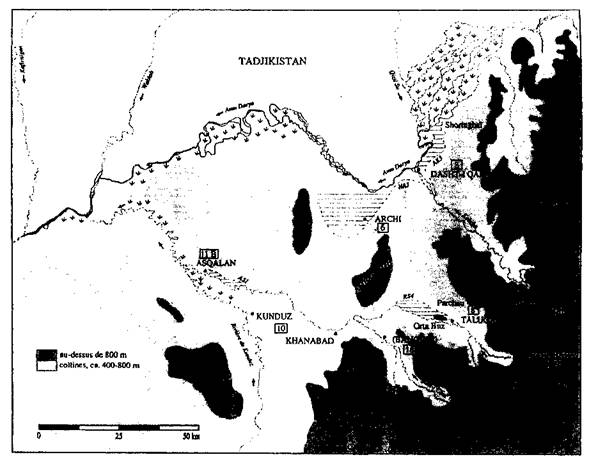
Fig. 3
Irrigation systems in the Hellenistic period (ca. 300 to 130 B.C.). Note in particular the appearance of canals drawn from the Rud-i Shahrawan (system RS) in hitherto unirrigated areas: the Hazar Bagh plateau (zone 5, canal HB1), the Khwaja Ghar plain (zone 4, canals KG1 and 2), the Archi terraces (zone 6), above Chichka (canal TK) and Chashma (canal НВ2І