Antonio Invemizzi THE CITADEL OF PARTHIAN NISA
Research in the royal Arsacid citadel of Old Nisa is far from having reached its conclusion. However, the considerable amount of evidence known today makes it possible to reconsider in a clearer light the results of the excavations carried out by the JuTAKE under the direction of M.E.Masson.1 These results were extraordinary as far as the architecture, art, handicrafts, and economy of the early Arsacids are concerned, but remained largely unpublished.
Those of the investigations subsequently carried out under the direction of V.M.Masson, V.N.Pilipko, G.A.Koselenko and myself confirm or complete the evidence available at that time.[85][86]As for the architecture, the buildings excavated show features belonging to a culture that has deep roots in Central Asia, and obviously not only from the technical point of view. The layouts of the individual monumental buildings give a highly original version of patterns which were possibly in common use there. The Square Hall may recall features that were widespread in Achaemenid palace architecture, but the important role played by the lantern ceiling as reconstructed by G.A.Pugacenkova shifts the formal balance in favour of the local tradition, in spite of its Hellenizing architectural decoration.[87] Even more original are the solutions shown in the layout and elevation of the Temple-Tower and the Round Hall, for which we do not have any precise analogues, today.
As for the Round Hall, in particular, the inspiration drawn from a Hellenistic model proposed by G.A.Pugacenkova in her famous reconstruction[88] can no longer be accepted today. ТЪе construction technique—ring of masonry inscribed in a square perimeter—is certainly local, and the shape of the space has a distinctly Oriental flavour, for a careful survey of the still standing masonry shows that the room was not covered by a hemispherical dome on a cylindrical drum, but by an elliptical dome rising directly from the floor.
Moreover, this vault shape does not leave any space for heavy columns in the upper band of the drum. It is even very doubtful whether similar columns were ever erected in the interior of the hall, for there are no traces of bases on the floor.On the other hand, the large columns attested to by the bricks of shafts and the acanthus leaves of capitals found in the filling of the Round Hall are unlikely to have decorated the exterior of the building at ground level: the fair state of preservation of the exterior masonry, protected by later additions, rules out the existence of a portico of free-standing columns as well as that of a row of half-columns leaning onto the facade. The fragments of columns and capitals found inside the Hall may actually have never belonged to it, and possibly fell into the room from the upper floor of one of the neighbouring buildings, perhaps from the small temple erected on the top of the Tower, after the vault of the Hall partly collapsed. The details of architectural decoration which are scattered everywhere in Old Nisa, even in places which cannot have been decorated with such architectural features, remind us that such fragments may come to lie far from their original place. However, it is quite reasonable that columns or possibly half-columns decorated the upper floor of the exterior on its free sides. This latter conclusion seems to be suggested by the reconstructive study carried out by N.Masturzo.
Among the monumental buildings of Old Nisa we must undoubtedly include the Square House (Fig. 1), which only in the course of time was turned into that extraordinary store-house of precious objects revealed by the excavations, a Treasury indeed.[89] Its square layout may once again remind us of features of imperial Achaemenid architecture. However, today we know that the great Central Asian tradition based on monumental square layouts has deep roots in pre-Achaemenian times. Moreover, with respect to the Achaemenian models, especially of the West, the formal definition of this pattern seems rather original, in the way a series of modular rooms is placed around the central courtyard.
A fairly close analogue may be found in pre-Hellenistic Central Asia in the Bactrian farmhouse at Kyzylcha-tepe (Fig. 2) dating from the 7th-4th centuries B.C.[90]The Square House also attracts attention for being the widest construction of the whole compound. In spite of its very linear layout and extremely simple, undecorated elevation, we can hardly imagine that it was conceived for the purely utilitarian aims of service to which its subsequent architectural phases attest. On the other hand, the
remaining service buildings, and in particular the wine cellars placed close to it, do not seem to belong to the original layout of the citadel. These structures and the internal modifications which the Square House underwent only prove that at a given moment the northern corner of the citadel was selected for various storing purposes. However, it is unlikely that this was the function for which the Square House was originally built.
Quite the contrary: its great size and monumentality are likely to be the result of very different requirements. First of all, it must be observed that the Square House is the most capacious building in the citadel: not only are the individual rooms of considerable size, but the large courtyard is itself a quite notable space. It must also be said that, if the hypothesis is correct that the main entrance to the citadel was in the western side of the ramparts, roughly on the line of the difference in level between the northern sector, later turned into a service area, and the southern sector, housing complex dwelling, service and representative activities, among the monumental buildings of the compound the Square House is the most easily accessible to anybody coming in from outside.
These features, capacity and accessibility, at first sight distinguish the Square House from the official spaces of the southern sector, where on the one hand only a few people were certainly admitted to the probably religious ceremonies performed on the summit of the Temple-Tower, while on the other hand the relatively reduced size of the Square Hall and Round Hall do not make these spaces suitable for the performance of ceremonies involving a considerable number of people.
The function of these spaces is not certain.[91] However, whatever its specific purpose was, the Square Hall seems suitable to play the role of main representative hall of the southern compound because of the magnificent sculptural and architectural setting it maintained in both phases of its existence, and because, of the three monumental buildings so far excavated in the southern sector, it is the closest to the citadel entrance. In the Square Hall the king may have given restricted audiences. Here, in what is apparently the most lavishly decorated room of the citadel, he may have appeared to his courtiers and subjects in full majesty.
By comparison, the very simple though grand and majestic space of the Round Hall has a decidedly more intimate appearance (Fig. 3). This room is also remote from the outer entrance to the citadel, and, in spite of its three entrances, access to it was not easy. Its main entrance is in the southern side, on the open area at the back of the monumental complex. Later, even the feasibility of a direct communication from the remaining buildings of this complex was removed by blocking the two northern passages and turning them into deep recesses. At that time, the western recess was provided with a basin on the floor, which seems to support the sacral interpretation given to the Hall. It is actually possible that the great round space was a kind of mausoleum in some way celebrating the glory of Arsacid kingship.
Therefore, it is clear that every building had its own special function and housed specific ceremonies. There is, however, no doubt that Nisa was not only an ideally representative centre, but an organism actually lived in by the sovereigns and, in their absence, maintained in efficient working order by an active royal administration. In the life of this organism the Square House, too, must have originally played a specific role. Which role this was, can be suggested by its internal setting itself: it must be
stressed that this is the sole monumental building in Nisa provided with a stable fixed setting, which of course was functional to its normal use: benches of clay placed around the walls of the rooms.
On these benches the excavators found some of the precious articles deposited there, once they were withdrawn and the building turned into a store-house.However, the aim for which these benches were originally constructed was undoubtedly quite different. Their purpose was probably that of permitting the celebration of court banquets, which in the Oriental and classical worlds were carried out in a lying, not in a sitting position. The public banquet was a ceremony of fundamental social importance in the Greek polis, as well as in the Hellenistic courts and religious communities of the Mediterranean and the Near East. We know very little of life at Oriental courts, but banquets must have been common practice, and in the Iranian world the religious toasts represented in Scythian art are particularly significant in this respect.
The Hellenistic age offers good evidence of rooms, even entire buildings, expressly built for banquets, in courts as well as in sanctuaries.[92] The Macedonian palace at Vergina (Fig. 4) is a particularly clear example: its entire ground floor served mainly for celebrating banquets by groups of table-companions lying on klinai placed in rooms of similar layout, arranged around the large central courtyard. Even more regular is the pattern of the Leonidaion at Olympia (Fig. 5). This is exactly the same principle and the same type of layout as we find in the Square House of Nisa, where the banquet rooms are rectangular instead of square and, following local custom, contain brick benches instead of movable beds.
The banquet was a central feature in the practice of Macedonian and Hellenistic kingship; we may rightly expect that it was an equally important practice for the Ar- sacids, especially in Hellenistic times. No matter about its lay or sacral nature, banquets may well have been of such fundamental importance at Nisa as to require the construction of a special building, under the stimulus of Hellenistic fashion but according to Oriental architectural practice.[93] Later, during the A.D.
centuries, performing banquets at Nisa probably fell into desuetude, and the banquet house of the old citadel was turned into a storeroom for precious objects. Therefore, the spectacular rhytons carved in ivory, once discarded, came to be laid precisely on one of those benches on which they once may have served royal guests. In earlier times, however, complete sets of these special drinking vessels may well have been used at formal banquets carried out in the Square House. Pugacenkova’s reconstruction of one room of this House (Fig. 6) may also give us a fairly precise idea of their use here.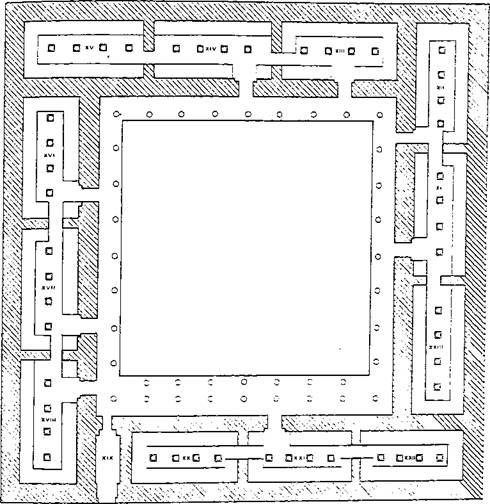
Fig. 1
Old Nisa: plan of the Square House
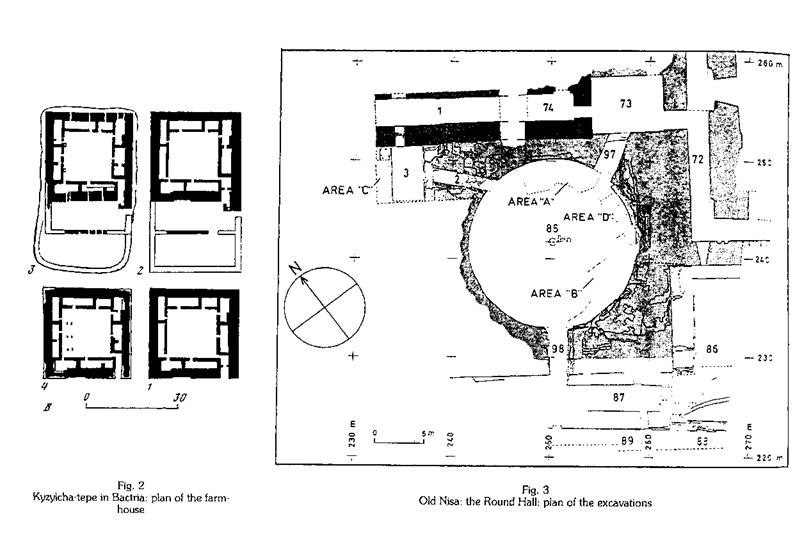
Fig. 4
Vergina in Macedonia: plan of the palace
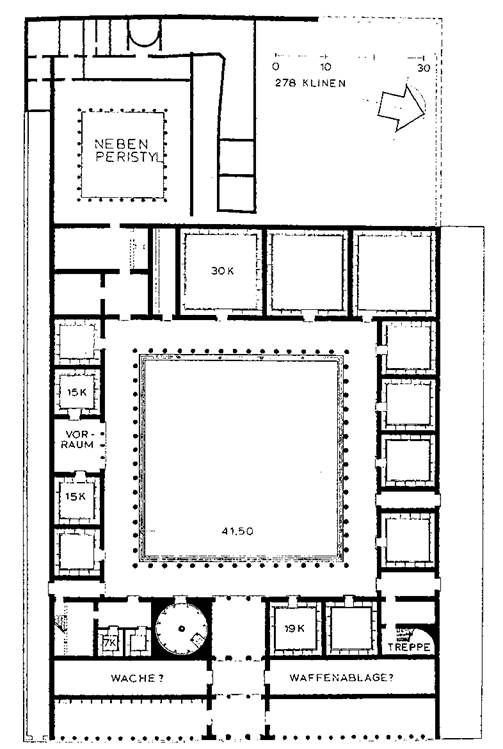

Fig. 5
Olympia: plan of the Leonidaion
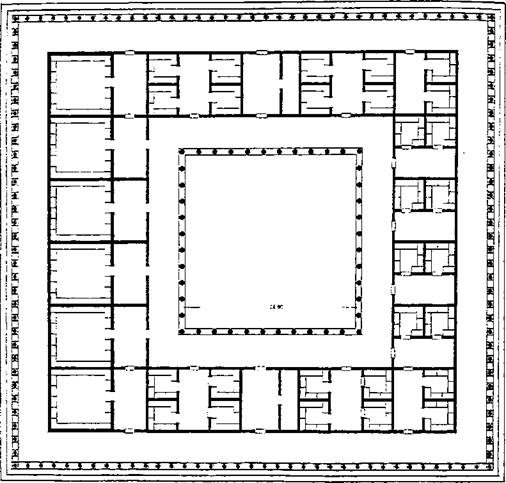
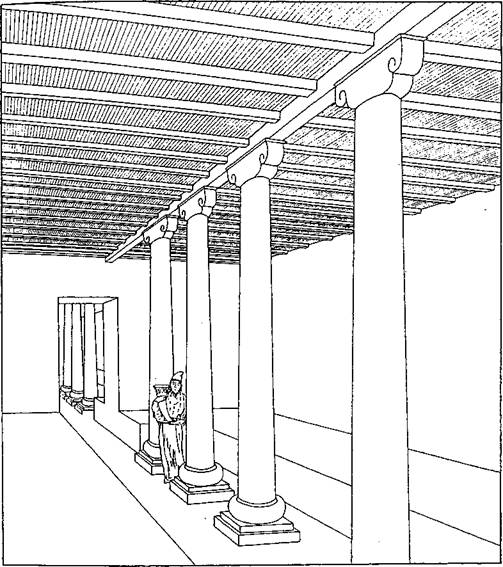
Fig. 6
Old Nisa: G.A.Puga6enkova’s reconstruction of a room in the Square House
Karl Jettmar
SECLUDED SANCTUARIES OF THE OXUS CULTURE
Almost 15 years ago I ventured to explain the so-called “temple-town” of Dashly-3 — discovered and partly excavated by Victor Sarianidi in Western Bactria (today in Afghanistan, not far from Balkh) — not as a temple (and the home of the priestly families) surrounded by outer quarters where the ordinary people had their places, but as an integrated structure used only for restricted periods. The population of the oasis once came together for a short time, a festival when important ceremonies were held avoiding contact to all outsiders who had not undergone the same purification.
I called the whole complex of Dashly-3 — not only the innermost part with its nine towers — a “ceremonial centre”. I assumed that the seclusion in this centre was the “realization” of a religious concept, still preserved until the end of the 19th century in the mythology of the Kafirs of the Hindukush. The texts collected by Morgenstieme (1951: 182-183) and Motamedi/Edelberg (1968) tell of a refuge for the souls (of the deceased): a golden castle with four comers, seven gates, and a tower as centre. From this tower seven streets leading to the nine gates of mercy are diverging (Jettmar 1981).
I observed that this would correspond to the plan of the “temple town” as reflected in the reconstruction based on Sarianidi’s observations, but also to the configuration conceived on the basis of the relevant text of the Videvdat for the “vara”, the subterranean but fortified elysium where the blessed survive the long winter, finally to recover and re-occupy the world (Widengren 1965: 52-54).
This proposal was not only accepted by Sarianidi. He contributed significant confirmations and elaborations on the basis of additional studies which were not at my disposal. Therefore his text (Sarianidi 1988: 112) is quoted here:
“K. Jettmar was the first one to compare the round temple with the ceremonial structure of kafires from Hindukush and also with the Avestian ‘vara’. It is true though, that up until recently, it was thought to be a ‘square vara’ but the latest translations of the corresponding extract from Avesta, done by I. M. Steblin- Kamenski, prove that it was a round building which consisted of three rings of walls with gates. According to the new version of the translation, within the central ring there was placed ‘semen of cattle, people, dogs, birds and also some red burning fires’, the second ring contained the dwellings of people and the third was occupied by cattle. In other words, the importance of the space increases towards the centre of the building, where the deities meet human beings (16, pp. 31-32). The seeming
© K. Jettmar, 2001
contradiction between the ‘square vara’ and the round sacred structure is easily explained by the reference to the general lay-out of Dashly-3 where both of these planning principles were combined. It may be considered proved, that the central part of Dashly-3 had secular meaning where fire played a leading role”.
As soon as this idea comes to the fore, there is only a short step to explain the so-called “palace” of Dashly-3 as a sacral and not secular building. The “palace” is a quadrangular courtyard originally with only a few buildings in the interior but with a complicated enclosure provided with protuberances in the form of hooks and T-shaped “bastions”.
When I showed slides during a lecture, the similarity of the resulting plan to a mandala became obvious. An interesting remark was made by M. v. Dewall: she compared it with Chinese mirrors of the type LTV. The decoration on the backside of this kind of Chinese mirrors is known to form a cosmogram. Since it is evident that there were connections between the Oxus culture and early China (Jettmar 1985: 154), we may assume the diffusion of ideas, finding expression in the “palace” — even in the Far East.
In the following years, Sarianidi started to excavate fortified places of the Achaemenid period with enigmatic ground-plans, constructed under the influence of related religious concepts (at Chapar and Kutlug Tepe). He could not proceed with his investigation due to the beginning of civil war in Afghanistan. After the Soviet invasion the situation became even worse.
As for Koj-Krylgan-Kala in Khorezm, similar to the “round buildings” of Dashly-3 and Kutlug Tepe (Jettmar 1981:227), I had seen the structural affinity to the “vara” and, already in 1975 (published in 1981 with additions written in 1978), I formulated the following hypothesis:
The stream of Near Eastern influence which had incited the erection of such buildings, caused as well the peculiarities of the most sophisticated “royal tombs”. The greatest kurgans in the steppes were not mere graves. They were the places where the yearly gathering of the royal tribe took place. In Arzhan a “Chakravartin” ruler was buried in a “model town”. In the outer quarters the tribes living in his realm deposited a symbolic escort for the journey to the other world — the body of a high- ranking chief and a fixed number of horses.
So the grave, and especially the royal graves, had a function comparable to that of the stupa. This is not only a structural affinity: constructive traits may be identical as already seen by Rapoport (1971: 51).
Here I want to follow another track. Writing a review of Sarianidi’s book on the Bronze Age of the land “Margush” (= Margiana), I found a good description of the temple complex Togolok-21 in this most stimulating work (Sarianidi 1990b: 102- 174). Togolok-21 is certainly related to the ceremonial centres of Bactria, belonging not only to the same time but to the same culture as well. (The term “Oxus culture” proposed by Francfort is more handy than Sarianidi’s “Bactriano-Margianic complex”.) However, I happened to stumble on something seen by Sarianidi, but not used as starting point for his interpretation: the temple complex was a rectangular, fortress-like building with integrated towers, surrounded by two further lines of fortifications. It has an impressive entrance, leading directly into the central building. Looking at the reconstruction, we can see the approaching visitors. If that ever has been like this, then not for a long time, as even at the first, basic stage of the evolution of the temple (p. 151, Fig. 35) this portal had been blocked by bricks. It had been walled
Togolok 21
with additional housings for the permanent staff of the temple fortress Gate period). After Sarianidi 1990
up. The same happened to the small gates on the backside of the main building and on the backside of the outer wall. Only in the inner wall one gate was left open, in order to connect the “living quarters” on the right flank of the periphery to those in the area surrounding the central building. Maybe it was essential for those accommodated outside the “central fortress” (the term used by Sarianidi) to preserve a permanent access to two additional sanctuaries situated on the fringe of the compound and included in the outermost wall. Certainly, as they are located in rectangular bulges protruding from the straight line of the walls, these sanctuaries were vegarded as something separate from the main constructive concept. In the eastern bulge two round constructions are visible (Sarianidi 1990b: 129-132). They were — convincingly explained as altars. The meaning of the other extension (the western complex, pp. 133-135) was not very successfully discussed by the colleagues, who gave their comments in two issues of “Vestnik drevnej istorii” (VDI, 1 (1989), 2 (1989)).
212
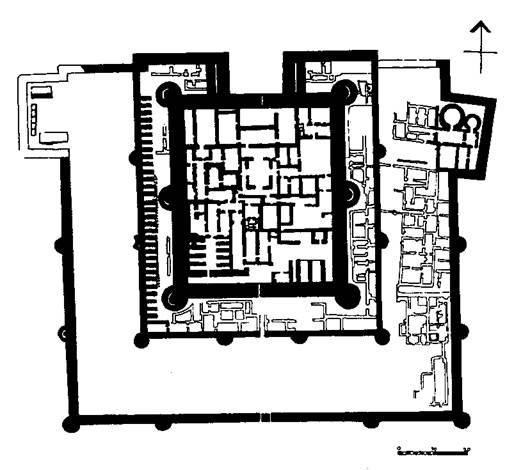
Controversial was the discussion on a row of more than 30 very small “chambers” (Sarianidi 1990b: 121-122). What was recognizable were actual walls, maybe two-and-half meters in length, perpendicularly leading off from the western middle wall (with towers). Sarianidi assumed that the very strange cabins resulting from this construction were too uncomfortable for the normal cult servants. So he came to the conclusion that the inhabitants of such cabins were perhaps “ascetics”. Maybe we should rather assume, that such cells were used for meditation. But, as in some of them there were remains of carpeting made of sheep or camels, they also might have been a regular, but hardly permanent, habitation. A larger cabin was explained as that of the overseer.
Nine similar, somewhat larger cells were observed on both sides of a corridor in the western part of the “central fortress”. Even they were considered cells of “ascetics” by Sarianidi, but veserved for the more competent the ceremonies held in these innermost premises. This explanation was called into question by the reviewers of Sarianidi’s representative report (Sarianidi 1989: 157, Gaibov/Koselenko 1989: 171), but they were not able to offer a better explanation. Sarianidi was perhaps too cautious to mention it clearly, but it is evident, that in his mind Togolok-21 was rather a sort of monastery — with two categories of adepts: the fully initiated ones occupying the inner precinct and the junior members normally confined to the outer area. In case that we accept this as a working hypothesis, the next question would be, how to imagine the relations between the two categories? Had the juniors a temporary access to the inner sanctum with the seniors as tutors?
An answer is suggested by the astonishing number of cult objects typical for the Oxus culture, discovered at Togolok-21. Due to their material (stone, here with metal mountings), these “miniature columns” had the best chance to be preserved without essential damage. They occur exclusively in the “central fortress”, but are not restricted to the official rooms (Sarianidi 1990b: 104-120). Two pieces were found in room 16, two in room 20 (and an incomplete one in room 9), two in room 28, two in room 25, three in room 14, whereas only a single one was discovered in the rooms 2, 15, 7, 39, 40 and 36. Together with other objects (Masson 1981: 66-69, Fig. 21, 22) the columns formed a set, the regular equipment of a sanctuary as seen in Altyn-Depe. Their actual use is still disputed, as far as I know. Maybe each consecrated priest needed such a specimen. Finally it was deposited in his grave.
For the ordinary service in a temple, an accumulation as in Togolok-21 only makes sense, if it were a sort of “training centre”, or — to use the terminology suitable to a religious context — a “seminary”, where novices were ordained to the ministry. Then the fact that both ephedra and poppy seeds were found in vessels discovered in the rooms 23 and 34 (Mejer-Melikjan 1990: 203) is not enigmatic any longer. It is not necessary to assert, that both were used for one and the same sacred intoxicant — the legendary “soma”. The chances are great that the priests of this early period were familiar with different kinds of drugs, and that the acolytes, during their “initiation”, were introduced to the secrets of production and the many rituals which they needed for officiating in the future by their spiritual fathers. The relevant teachings in complete separation from the outer world were hardly available to everybody, but only to a chosen few. We might assume that the initiated were the boys of a priestly tribe — like the Magi (Herodotus I, 132, 148, etc.), but we are in the second millennium B.C., maybe in an even earlier period (the dating is still under
dispute), and there were perhaps different priestly communities, all stimulated by Near Eastern influence, later on converging into one tradition.
When I became aware of this complex, the affinities with the great mystery religion of Iranian origin, Mithraism, almost tempted me to the statement that Sarianidi’s insistent attempts to explain Togolok-21 as a proto-Zoroastrian sanctuary lead the attention into a wrong direction: instead, we should rather call Togolok-21 a “proto- Mithraeum”. To overlook the disparities would lead us astray as well.
If the cabins in and outside the “central fortress” really were the temporary accommodation for the teachers and their pupils, we still have no argument to assume a hierarchic differentiation of the believers — an essential element of the late, well- known elaboration of the Mithraic cult. Was Mitra/Mithra really the main deity venerated at Togolok-21? Yama/Yima could be an alternative. But still, one of the (several) roots of the later Mithraic complex could go back to the Oxus culture. F. Grenet already recognized that (in his contribution to the discussion in VDI 1/1989: 170):
“By the study of the iconography of the seals and ritual vessels of the Margiano- Bactrian Archaeological Complex we are faced with a problem, since we find a veritable anthology of the xrafstra’, the crawling animals which are considered demonic in Zoroastrism (snake, scorpion, etc.). The analogies, which immediately call into mind this repertoire, are to be found in the western Mithraism. We have in view such themes as the snakes grasping and sucking the sexual organ of the bull, or crawling on the rim of the sacrificial vessel. Did Mithraism preserve some motifs inherited from the proto-Zoroastrian religion? The new discoveries in Margiana surprisingly speak in favour of such a point of view, which was previously upheld by R.C. Zaehner (1955) and I. Gershevitch (1959). However, it should be remembered that such affinities remain very dangerous as long as no new documents fill the chronological and geographic distance”. (Translated from the Russian text by K. Jettmar.)
However, Grenet did not stress the essential problem. Was there a positive valuation of the “crawling animals” in the demonology (or pantheon?) of the Mar- giano-Bactrian Archaeological Complex? Did such a concept survive in spite of the negative connotations of the same animals in later texts (Widengren 1965: 112)? The importance of the crawling animals was already observed by Sarianidi. His idea that proto-Zoroastrian elements must be involved was explained by the scenes visible on the seal-amulets — namely, “sacred animals” in the centre surrounded by others, among them snakes and insects as confrontation between the light and the dark forces. However, no actual fighting is to be seen. In case that a snake or a centipede sucks the semen of the bull or ram, we might as well assume, that the life-force shall be saved or brought to the “vara”, the “celestial” refuge. Many seal-amulets show crawling animals and nothing else. It is a poor explanation to assume that the owner used the image of such an embarrassing being as personal symbol for pacifying one of the dangerous demons represented by them.
In one of the plundered graves in Bactria, a necklace with a golden pendant in the shape of a scorpion was found (Salvatore 1988: Pl. 64). Certainly that was not meant as an appeasement. This crawling animal apparently had a respected place in the world of the spirits of the Oxus culture, different from that of the great quadrupeds — they became exclusively symbols of evil in a later phase.
If a “priestly tribe” really existed, we cannot be sure that is was ethnically identical to the rest of the population. The book of Amiet (1986: 209-214), the best introduction to the problems of the Oxus culture, concludes with the vision that in the
lands of Outer Iran the basic population had a rather modest, but well adapted cultural inventory.
Very sophisticated products, however, were provided by trained craftsmen and artists using imported raw materials like chlorite, serpentine and alabaster. Amiet (1988: 137) assumed “an aristocracy composed of nomad-artisans with strong Elamite affinities”. However, one substantial correction is necessary: the most influential elite with Elamite affinities were not the artisans, but the priests. Their presence is revealed by what is called “the Bactrian fortresses which seem more like prestige castles which could have been used as caravanserais or warehouses” (Amiet 1988: 137). For such purposes a building complex without visible entrance and a very complicated ground-plan would be most inappropriate. By no means it would fit into the rather eccentric concept of a prestige fortress. Here reality had surpassed the fantasy of very imaginative scholars.
Togolok-21 is not the only “castle without doors”. The otherwise quite different complexes in the — already mentioned — locality of Dashly-3 in Bactria, have the same odd peculiarity. In the temple-fortress Tillja Tepe (Sarianidi 1989b: 7—21) there was a gate on the northern front, but the entrance to the hall was on the opposite side. So the worshippers had to reach the sanctuary by a round-about walk. In such buildings no statues were found, the cult might have been uniconic.
The hypothesis that the religious tradition culminating in western Mithraism was rooted in the same region as Zoroastrism, namely in the eastern periphery of the Iranian tribes among sedentaries and semi-nomads, could be the result of our investigation. The esoteric character of the teaching could explain the difficulty of tracing the actual routes of diffusion from the extreme East to the extreme West. However, several important stages are well-known and were comprehensively described, e.g., by Merkelbach (1984: 9—72). Particularly this author considered the transformation into a secret cult (“Geheimkult”) as a late “invention”. According to him, religions of this type occur during the imperial period of Rome, not earlier. Maybe the inventor (“Erfinder”) lived in Rome, having a good knowledge of the Persian religion (Merkelbach 1984: 77).
According to my opinion, esoteric cults already existed in palaeolithic times. Since then they inspired numberless sophisticated and well-organized religions and churches. Such a creative process is indicated by the “secluded temple fortresses” of the Oxus culture. The credibility of this hypothesis would be considerably improved if we could trace other offshoots of the same roots going back to a similar level.
We can. The most conservative “tribes of the Hindukush”, the speakers of Nuris- tani languages, who had defended their pagan religions up to the end of the nineteenth century A.D. (and therefore were called “Kafirs”, i.e., “unbelievers”, by their Muslim neighbours), have several more cultural peculiarities, which might be explained by origins going back to the complex revealed by the temple-fortresses of the Oxus culture. In a chapter added to the first part of the English edition of “Die Relig- ionen des Hindukusch” (Jettmar 1986: 143-147), I tried to prove that the ancestors of the Kafirs once formed a part of the people who had created the Oxus culture, preserving many archaic beliefs and customs. That may explain the linguistic situation: Kafiri branched off before the Iranian languages were separated from the Indo- Aryan stock. The same idea was drawn up by Parpola (1988: 236-248), who mentioned Togolok-21 in this context. The distance — as the crow flies — between the presumable borders of the Oxus culture and the homeland of the Kafirs, is less than
one hundred kilometres, but the Kafirs reached the hidden and secluded valleys not directly, as we may assume. Understandably, I had not all arguments at my disposal, when I wrote my supplement. Besides, we should take the religious heritage of the neighbouring Dardic (Indian) population into account, as they were deeply influenced by the “Kafir” tribes (cf. Parkes 1988).
Wolfgang Lentz (1974) saw similarities between the legend of Mithras, as reflected by materials collected in Western Asia, North Africa and Europe, and the mythical tales about the deeds of the main Kafir deity “Imra”. More substantial are the deliberations starting from what we know about the central temple of the Kafirs, situated at Kushteke in the Prasun valley. The veneration — common to all Kafir “tribes” — was shared by a Dardic population, the Kalash, pagans up to the present day. Relevant information has been brought to our notice by Parkes (1991: 85). I quote his study, omitting the parallel Kalash terms: “Most intriguing, however, are references to the ‘underworld pillar’ inside the temple. This is said to be constructed out of iron and decorated with ‘sacred designs’ from which all Kalasha ritual iconography is derived. Most prevalent are the typical ‘temple carvings’ of interlaced knots, or of entangled horns and shield motifs (see Wutt, 19876). But the ‘underworld pillar’ was also said to be emblazoned with figures of intertwined snakes, frogs, centipedes, and scorpions: sacred animals that also recur in other Kalasha traditions about the hidden world”. (Parkes 1991: 85).
Other passages in Parkes’ text are equally interesting, e.g.: “The ‘underworld pillar’ of Wetdesh has, however, a greater cosmological significance in Kalasha tradition than is evident from Robertson’s account of Imra’s rod or iron bar. It appears to be none other than the world’s axis, situated at the very centre of the world and descending to the underworld of the deceased. There it is said to rest upon the navel of an outstretched giant, the lord of the underworld Mir Mara of Min(j) Mara”. (Parkes 1991: 86-87).
Equally relevant are beliefs in the adjacent area which is settled by Dardic Khowar-speakers (reported by Jettmar 1975: 434). Here the cattle has a protective spirit appearing as a centipede. Such an insect is never killed lest a cow or bull sould die. The protecting spirit of the house may appear as a snake — a bowl of milk is offered then. When the milk is swallowed by the snake, it means an excellent omen. In Northern Chitral, the same term, however, which is used for the protecting spirit in the shape of a crawling animal, means the ancestor, male or female, who is in charge of protecting the whole lineage.
It is easier to understand such beliefs if we consider them in the frame of the basic cosmological model (Jettmar 1975: 432-434 1986: 36-38). The world is divided into three spheres. The upper sphere is encompassing the various superimposed storeys for the deities. Below that is the middle sphere, the earth giving room to human activities, and again below there is the underworld, housing the demons and the dead; Heaven and Hell are situated there. The whole hierarchical construction is pegged together by the world pillar. As for the crawling animals they may appear on earth and feed from the offerings presented to them. The well-being of the other inhabitants of the hidden world as well depends on such offerings. If they are neglected, their wrath will lead to terrible earthquakes.
Referring to this concept, we may speculate about the meaning of the motifs occurring in the glyptic art of the Oxus culture, one of them reflected by the famous Mithraic reliefs, centuries later. The crouching animals, resurgent from the under
world, are waiting for their share. They are not aggressive themselves, but they must bring the life-essence to the demons and to the souls of the dead. They are present, when the bull — the representative of the middle sphere — is killed by the divine hero.
But such enquiries are far beyond the aims of this study, as I wanted to offer a contribution to the explanation of the so far unexplained peculiarity of the groundplan of Togolok-21, and not more. It may be condensed as follows:
It was a complex of buildings and squares without ‘^visible” gates. If Sarianidi s interpretation of the “cabins” is correct, there were sleeping quarters for nine persons in the “inner quarters”, and more than thirty in the “outer quarters” — with a single small but open access to the peripheral precincts. In the inner quarters there were rooms for the preparation of drugs and many chambers in a complicated order, maybe built with the intention to offer suitable places for different ceremonies. The accommodations for the novices and their tutors were hardly designed as permanent, rather they were intended for restricted periods. So the endurance of considerable hardship could be expected.
Such a complicated compound would be an ideal arena for the implementation of a ritual kind of training, under perfect secrecy. Perhaps it meant the transition into the next age-grade, a ceremony understood under the term “initiation” by anthropologists. However, it is not reasonable to assume that all young males of the land Margush (Sarianidi 1990a, fig. 1) had the right to participate. Paraphernalia of the priests including the “stone columns” were not found in most of the graves. So it is better to postulate the existence of a priestly tribe.
Later development can be explained by a change in the principle of selection: everybody could compete proving himself worthwhile. That opened the way to a mystery religion.
Under ethnographic conditions development took another direction. If, in the process of promotion, more and more economic and martial performances were demanded, the proven success being confirmed by a feast given to the whole community, then we are rather on the turning point into a graded society with trophyhunting and “feasts of merit”. Not the spiritual progress is any longer the main matter of concern, but the acquisition of an elevated social position expressed by symbols of rank. Such was the situation in Kafiristan.
REFERENCES
Amiet, P. “L’age des ^changes interiraniens 3500-1700 avant J.-СЛ Notes et Documents des Musdes de France 11, 1986.
Berezkin, Ju. E. “ ‘Gorod masterov’ na drevnevonsto£noj periferii. Planirovka poselenija і social’naja struktura Altyn-depe v III tys. do п.ё.” VDI3, 1994:14-37. (Here and elsewhere VDI stands for the Vestnik Drevnej Istorii: “Journal of Ancient History , Moscow.) Gaibov, V.A., Koshelenko, G.V. “Togolok 21 і problemy religioznoj istorii drevnej Margiany”. VDI 1, 1989:171-173.
Gershevich, I. The Avestan Hymn to Mithra. Cambridge, 1959.
Grenet, F. “Nekotorye zamechanija о komjakh zoroastrizma v Srednej Azii . VDI 1, 1989:170-171. t— j £ i. -ru.^
Jarrige, J.F., Usman Hassan, M. “Funerary Complexes in Baluchistan at the End of the Third Millennium in the Light of Recent Discoveries at Mehrgarh and Quetta”. South Asian Archaeology. Copenhagen, 1985:150-166.
Jettmar, К. “Die Religionen des Hindukusch”. Die Religionen der Menschheit 4.1. Stuttgart, 1975.
____ . “Fortified ‘Ceremonial Centres’ of the Indo-Iranians”. In Entnicheskie problemy istorii Central’noj Azii v drevnosti, Proceedings of the International Symposium on the Ethnic Problems of the Ancient History of Central Asia: the 2nd Millennium B.C. Moscow, 1981a:220-229.
____ . “Die Bedeutung politischer Zentren fur die Entstehung der Reitemomaden Zentrala- siens”. In Die Nomaden in Geschichte und Gegenwart. Verdffentlichungen des Museums fur Volkerkunde zu Leipzig 33. Berlin, 1981b:49-70.
____ . “Cultures and Ethnic Groups West of China in the Second and First Millennia B.C. Asian Perspectives”. SSIV1, (1981), 1985:145-162.
____ . The Religions of Hindukush, vol. 1: The Religion of the Kafirs (with contributions of Schuyler Jones and Max Klimburg, and a Glossary by Peter S. Parkes). Warminster, 1986.
Lentz, W. “Western Parallels to the Deeds of Imra”. In “Cultures of the Hindukush”. BeitrSge zur Stidasiensforschung 1. Wiesbaden, 1974:31-36.
Masson, V.M. “Altyn-depe”. Trudy Juzhno-Turkmenistanskoj arkheologicheskoj kompleksnoj dkspedicii 18. Leningrad, 1981.
Mejer-Melikjan, H.P. “Opredelenie rastitel’nykh ostatkov iz Togolok 21”. In Sarianidi 1990, 1990:203-205.
Merkelbach, R. Mithras. Berlin: Kdnigstein’s, 1984.
Morgenstieme, G. “Some Kati Myths and Hymns”. Acta Orientalia 21. Copenhagen, 1951:161-189.
Motamedi, A., Edelberg, L. “A Kafir Goddess”. Arts Asiatiques 18, 1968:3-21.
Parkes, P. “Livestock Symbolism and Pastoral Ideology among the Kafirs of the Hindukush”. Man (N.S.) 22,4, 1988:636-660.
____ . “Temple of Imra, Temple of Mahadeu: A Kafir Sanctuary in Kalash Cosmology”. Bulletin of the School of Oriental and African Studies 54,1, 1991:75-103.
Parpola, A. “The Coming of the Aryans to Iran and India and the Cultural and Ethnic Identity of the Dasas”. Studia Orientalia (The Finnish Oriental Society) 64, 1988:195-302.
Rapoport, Ju. A. “Iz istorii religii drevnego Khorezma (ossuarii)”. Trudy Khorezmskoj Ark- heologo-etnograficheskoj ekspedicii 6. Moscow, 1971.
Salvatori, S. “Early Bactrian Objects in Private Collections”. In Lingabue, G., Salvatori, S., eds. Bactria. Venezia, 1988:181-187.
Sarianidi, V. “Drevnie zemledel’cy Afganistana”. Materialy Sovetsko-Afganskoj ekspedicii 1969-1973 gg. Moscow, 1974.
_____ . Drevnosti strany Margush. Ashkhabad, 1990b.
____ . “Issledovanie pamjatnikov daSlinskogo oazisa. Drevnjaja Baktrija Г. Materialy Sovetsko-Afganskoj ekspedicii 1969-1973gg. Moscow, 1976:21-86.
_____ . Khram і nekropoT Tilljatepe. Moscow, 1989c.
____ . “Protozoroastrijskij khram v Margiane і problema vozniknovenija zoroastrizma”. VDI 1, 1989a: 152-169.
____ . “Soviet Excavations in Bactria: The Bronze Age”. In Lingabue, G., Salvatori, S., eds. Bactria. Venezia, 1988:107-123.
____ . “Togolok 21—an Indo-Iranian Temple in Karakorum”. Bulletin of the Asia Institute in Honour of Richard Nelson Frye (N.S.) 4, 1990a:159-165.
____ . “Zoroastrijskaja problema v svete novejshikh arkheologicheskikh otkrytij”. VDI 2, 1989b:178-181.
Widegren, G. “Die Religionen Irans”. Die Religionen der Menschheit 14. Stuttgart, 1965. Wutt, K. “Uber Zeichen und Omamente der Kalash in Chitral”. Archiv far Volkerkunde 30.
Wien, 1976:137-173.
Zaehner, R.C. Zurvan: A Zoroastrian Dilemma. Oxford, 1955.
Hans-Joachim Klimkeit
THE QUESTION OF IMAGE WORSHIP IN MANICHAEISM
Recently W.Sundermann published an excellent photo edition of Iranian Manichaean texts from Central Asia.1 On the basis of this edition, P.O.Skjaervo provided an edition and translation of the polemical hymns in M 28 I, which have hitherto been only published partially.[94][95] There are in the Middle Persian text, as it now becomes clear, three polemical hymns, of which two are concerned with image worship. The main verses that pertain to our subject are supplemented by two texts. The first of these is M 219 V (Boyce 1975, text dl), which Skjaervo renders thus:
“Seize the path of the gods..., the head of (?) all these which are painted here. This is a place of worship of idols which they call the house of gods. And by the (mere) name ‘house of gods’ they are lost. They run in droves. When one asks ‘Whereto?’, they say: ‘To the house of gods for worship and devotion and offerings before them.’ And the masters of the .idol temples call out: ‘Come to the house of the gods!’ And inside the house of the gods there are no gods. And those that are deceived cannot explain, for they have been intoxicated by the winds”.[96]
As Skjaervo stresses, “especially noteworthy is the use of the verb wift- (wiyift-), ‘deceive, lead astray,’ which is applied both to the deceived worshippers and to the idols themselves”.[97]
It is quite clear that these idols are false gods in a Manichaean sense. As the text says, they are “painted here” in a place referred to as “the house of the gods”. But this is a false designation for they are not true gods. Rather, they are gods that “deceive” and that thus ultimately represent the “lie” (drwg). They are “false” and “lying” {drwgmyg).
This meaning is made clear in the second document that Skjaervo cites, i.e. M 174 П R. Here it speaks of “the idol worshippers who worship the images, the god of ‘Lyinghood’”, and it parallels this with “the deceived teachings”.[98] The false teachings and the false gods are hence most intimately related to one another.
The fact that the idols themselves are deceived is clearly expressed in the first hymn of M 28 I. Here it says in Skjaerv0's translation:
“The worlds are amazed
at the deceived idols, the images over the walls: wooden and stony.
They fear (stand in awe of ?) the deception.
They bend down and do homage to it. They have abandoned the father who (is) in paradise, and they worship the deception”.[99]
In the second hymn of our text, there is criticism of the fact that the opponents, whoever they were, “painted the child of god... and (thus) made it bom”.[100] We leave open whether this is a criticism of Byzantine Christians, who painted Mary and the child in holy images. At any rate, it is clear that these mislead believers are dealt with as critically as the fire worshippers, of whom it says:
“Lo! Again, these too who worship the burning fire, they themselves know that from here their end is to the fire”.[101]
Summing it all up, the second last verse says:
“In the end they will be brought to shame all those who worship the idols, on that last day, and they will go to destruction”.[102]
It is here quite clearly expressed that it is the veneration of the image of false gods, of idols, be they painted or fabricated of wood or stone, that will lead to divine punishment. This is closely associated with the adherence to false religious views, i.e. to non-Manichaean forms of belief. Such can be referred to as the “dogmas”, and we learn in the missionary history M 2 that Mar Adds brought to naught such “dogmas”, or other creeds. Thus it says in the text mentioned: “He rose up against the (foreign) religions and thrived in every respect. He subjugated the religions [dogmas], and he came up to Alexandria”.[103]
The question is whether the polemics against the worship of idols also pertains to the veneration of Manichaean images.
That there were Manichaean images is clear. Thus, at the Bema festival, a picture
of Mani was placed on a five-stepped altar or “seat” in front of the sanctuary11, and the Bema hymns we have make clear that Mani was not onty invoked, but also venerated.
This is quite in accordance with Homilies 6, 15, where the soul, addressing Mani, prays: “May your image appear before me”. The image of Mani is, then, actually praised, both in western and eastern Bema hymns.[104][105]
Beside the picture of Mani used at the Bema ceremony, there must have been, at least in eastern Manichaeism, images of Mani to be found at prominent positions in the sanctuaries. One such image of Mani, referred to in the accompanying inscription as the “Buddha of Light”, is actually preserved in a Manichaean sanctuary near Quanzhou in Fujien, South China.[106] It is certainly late, dating from 1445. But it is quite probable that such images of Mani were also common in Central Asia, especially in the Turfan area, and perhaps at times also in Iran and Mesopotamia. Their veneration would be quite in accordance with the hymns to Mani that have been preserved in Iranian languages as well as in Uighur (Old Turkish).[107] The Turkish “Great Hymn to Mani” repeatedly mentions the preparedness of the hymn-singer to worship him. Thus it says in verse 2:
“We have prepared ourselves
To worship you with a humble heart. Accept now, (our) hope and refuge [All] the worship of every one (of us)”.[108]
Of course these hymns do not explicitly say that such worship was to take place before the image of Mani. But, given the fact that there were such images, veneration of the founder of the religion before his image is well conceivable, especially when it says, in the same “Great hymn to Mani” (v. 117a & b):
“We bow our heads in worship Before you, our highest God”.[109]
We can well imagine the veneration before the Mani image to have been similar to the Buddhist veneration of the Buddha figure, which was also addressed with hymns of praise.
Beside Mani, other deities were also represented in painting, and maybe even in sculpture. We have no unequivocal evidence that such images were worshipped, but the hymns in praise of a number of such deities would not exclude this. First and foremost, the Father of Light is to be mentioned. Invocations of him are to be found repeatedly, in Coptic and Central Asian texts. A case in point are the Iranian Turfan hymnS to the Fattier of Light.[110] There it says in one hymn:
“You are worthy of praise, beneficent Father, primeval Ancestor!
Blessed are you, beneficent God!
All gods and aeons, the deities of Light,
And the righteous bring praise (to you), saying ‘holy’ repeatedly”.[111]
In the hymns, the Father of Light is sometimes referred to as encompassing and surpassing all fair forms that issue forth from him. Thus it says in a hymn to him:
“You are the Father of aU these fair forms (Aari£n), jewels [i.e. gods], strong ones of Light and mighty ones that have been called forth [from you]...”[112]
On the one hand, there are indications in Manichaean literature that the Father of Light could not be depicted. In the Kephalaia (151, 20ff.) it says that as the God of truth he is “hidden in his kingdom, not displayed before this outer desolation”. Other Coptic texts speak of the “veil” by which the Kingdom of Light is hidden from the world.[113]Homilies 14, 14 promises that in the end the Father of Light “wiH unveil for them his image”. Thus this is an eschatological event. According to the Psalm-Book (= PsB), however, a spiritual person can now see God and the gods with the “eyes of Light” (PsB 19, 22ff.). Of the divine beings it says (PsB 101, 24):
“The joyous eye of my soul looks at them”.
The eye of light, or of the soul, is undoubtedly meant, when it says in Mani’s hymn “Praise of the Lesser Ones” (QSudagan Afriwan}:
“Father, we would cafl upon you, we would lift up (our) eyes to you”.[114]
The Chinese Hymn-Scroll (= H) speaks of the “light eyes” of the “dharma nature”, i.e. of the soul, and it refers at the same time to the “light ears” and other senses of the “dharma nature”. Thus it says in H56:
“Open my light eyes of the Law [i.e. dharma] nature, So that they see, without obstacle, the four-placed body [i.e. the Father of Light]”.[115]
This corresponds to hearing the Law with the ’’light ears". So it says in H 57:
“Open my light ears of the Law Nature,
So that they hear without obstacle the voice of the wonderful Law”.[116]
It is again in reference to the “eyes of light”, when it says in H 62:
“May I always see the compassionate Father,
Never again suffer in the tortures of birth and death in transmigrations”.[117]
All this would indicate that seeing the Father was merely a visionary experience, since seeing the image and hearing the word stand in such close connection to each other that forgetting the message corresponds to blindness.[118] In a psalm on the fate of the soul, the psalmist can lament the fact that he has been blind to divine realities:
“О bright God, dear soul! Who has blinded your eye of light?”[119]
Although there is no direct indication that the Father of Light, whose surpassing beauty is praised repeatedly, was outwardly depicted, we do have a depiction of a deity in an illustrated manuscript which could be interpreted as the Father of Light[120], since it represents a solemn figure whose head is surrounded by a number of smaller figures, their original number perhaps being twelve. This is reminiscent of hymns to the Father, where he is described as being surrounded by twelve “aeons” or “great ones”.[121] Of course this picture is not an image meant to be venerated. Yet the great urge and desire to see the noble form of the Father, expressed repeatedly in Iranian hymns, could suggest that there might have been images of him, as there were images of the Buddha, though a visionary experience of him was actually sought for. Thus in a Parthian hymn to the Father of Greatness we read:
“Be merciful to us in (your) mercy:
Show us your form (fihrag), the noble epiphany (padgirb), for which we yearn”.[122]
Considering the great significance of the cult, it would indeed be surprising if the symbols — or even images — of the Father in that cult lacked.
It should finally be pointed out here that according to an Iranian text, the “Hymn of the Joyful”, Mani’s divinity is emphasized by the fact that he is “similar in appearance to the God Zurvan”, i.e. the Father of Greatness[123].
Beside Mani and the Light Father, Jesus, i.e. the Manichaean “Jesus the Splendour”, also played a major role in the cultic texts of the Manichaeans. Not only is an encompassing portion of the Coptic Bema Psalms entitled “Psalms to Jesus”; Jesus also played an important role in eastern Manichaeism[124]. Thus it says in the “Psalms to Jesus” (PsB 61, 14ff.):
“The beautiful image, my Father, — reveal it to me... And thy sullied brightness, the confirmation of my soul”.
The Manichaean Jesus the Splendour basically represents a “Call” from the other world, his word and image being related to each other. Manichaean literature contains a number of promises to the soul of the religious person that he will be able to envision the joyous image of Christ as one who has gained salvation. In worshipping the image of the Redeemer, the psalmist declares that he loved it before he saw it, when it approached him in the form of the word (PsB 84, 24f.).
Whether there were images of Jesus that were venerated is also not known. He was, however, depicted in painting. We have a sketch of a painting on silk, made by A.Griinwedel, which shows a deity, sitting in the fashion of a Buddha, on a lotus throne, but holding a staff crowned with a cross.[125] In front of this seated figure is a little boy, apparently engaged in conversation with the main figure. We can connect this picture with the Parthian text M 42, where a boy, symbol of the soul yearning for salvation,
asks Jesus about the time of his appearance, and hence his own redemption.[126] Jesus consoles him and admonishes him to patience.
A special form of appearance of Jesus the Splendour is the Moon. Thus in a Turkish text on Jesus, as the God of the Moon, it says:
“from] the sight of your appearance (koity
We have become very joyful.
You are the wise, royal, mighty, radiant God”.[127]
From al-Bimni we learn that the images of the Sun and the Moon, representing probably the Third Messenger and Jesus, were venerated by the Manichaeans. Al-Вїгйпі tells us that Mani said:
“The adherents of (other) religions reproach us for worshipping the Sun and the Moon and for setting them up like idols. For they do not know their (i.e. the Sun’s and Moon’s) nature, i.e. that they are (our vehicles) to cross over and are the doors of our exit to the world of our (true) nature, as Jesus proclaimed”.[128][129]
Even if the images, or symbols, of Sun and Moon were set up “like idols”, to be venerated, the Manichaean texts again refer repeatedly to the envisioning of these deities by the spiritual eye. In this case especially the image of Jesus envisioned is a concretization of the “Call” from the beyond. With reference to this image, or figure, it says in a Persian hymn praising Jesus the Vivifier:
“And we would lift up our eyes to your (beautiful) figure, And we would open our mouths to call upon you”.
Hence seeing and calling are closely related to each other - here, and with respect to seeing, the beauty of the form seen is repeatedly stressed. Thus it says in Mani’s “Praise of the Great Ones” (Wuzurgan African):
“Praised, living, vigilant and immortal are you, oh (beautiful) form, Lord Jesus the Splendour, best loved of all beings of Light, Ruler, Messiah!
Praised, living, vigilant and immortal are you, oh (blessed) sign, Spirit and (beautiful) form, Lord Jesus the Splendour”.[130]
Though endowed with a beautiful form, the special thing about the saviour Jesus is that he can transform that figure in order to deceive the demons. But of course such transformation would hardly be depicted in art.
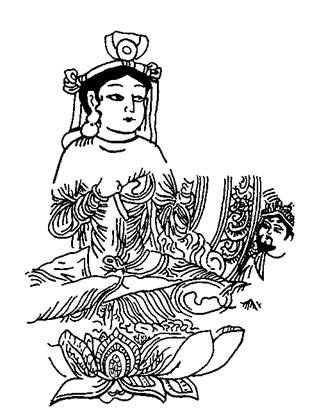
Of the remaining Manichaean deities, it is especially the Virgin of Light who is depicted in various instances in the art of Turfan. The most striking of these figures is that of a goddess sitting cross-legged in Indian fashion on a lotus throne. We have a sketch of the wall painting by A. Grilnwedel.[131] Being a young goddess, it is virtually the Maiden of Light alone that comes into question for the interpretation of that picture. We can well imagine that there might have been images of this type, made of wood or stone, and used for devotional purposes in a cultic setting.
The Manichaean Virgin of Light, a wall painting
In summing up we can presume that various divine figures of Manichaeism were represented visually, not only in book illustrations, but also as objects of worship. The proofs we have are, of course, slim. Yet it is to be assumed that the Manichaeans, living in close proximity to the Buddhists, and adapting to the linguistic usage of the Buddhists, would have adopted the Buddhist practice of revering images. It is quite clear that this is at least so in the case of Mani, a sacred image of whom is preserved to this very day. Apparently inspired by the image of Mani, a section in the Chinese Compendium explains the image theologically. In the second article, “On the style of his bodily signs”, we read:
“The nimbus of Mani, the Buddha of Light, being twelve-fold is the excellent sign of the Kingdom of Light. (His) body fully displaying the Great Light has the esoteric meaning of the Limitless. (His) wonderful appearance is outstanding, without equal among men and gods. (His) being clad in a white robe symbolizes the four pure dharmakayas [i.e. God, his Light, his Power and his Wisdom]. His occupying the white throne depicts the five vajra lands. The union and separation of the two realms and the purport and trend of the before and the after are apparent in true bearing and can be perceived if (one) looks at him”.39
[1] Haloun/Henning 1952: 194.
8 - 4820
225
The outer image was probably only an inspiration for a spiritual vision of the Saviour Mani. This would also have been true of other deities that were depicted in pictures, and maybe even in images.
REFERENCES
Adam, A., ed. Texte zum Manichaismus (Kleine Texte fiir Vorlesungen und LJbungen 175). 2nd ed. Berlin, 1969.
Allberry, C.R.C., ed. A Manichaean Psalm-Book. Part II (Manichaean Manuscripts in the Chester Beatty Collection II). Stuttgart, 1938.
____ . “Das maniaische Bema-Fest”. Zeitschrift fiir die Neutestamentliche Wissenschaft 37, 1938:2-10.
Amold-Doben, V. Die Bildersprache des Manichaismus (Arbeitsmaterialien zur Religions- geschichte 3). Cologne, 1978.
Boyce, M. A Reader in Manichaean Middle Persian and Parthian (Acta Iranica 9). Leiden, 1975.
Bryder, P. “...Where the Faint Traces of Manichaeism Disappear”. Altorientalische For- schungen 15, 1988:201-208.
Griinwedel, A. Alt-Kutscha. Berlin, 1920.
Haloun, G., Henning, W.B. “The Compendium of the Doctrines and Styles of the Teaching of Mani, the Buddha of Light”. Asia Major (N.S.) 3. London, 1952:184-212.
Henning, W.B. Ein manichaisches Bet- und Beichtbuch (Abhandlungen der Preussischen Akademie der Wissenschaften. Philosophisch-historische Klasse 10, 1936). Berlin, 1937.
Klimkeit, H.-J. Gnosis on the Silk Road. Gnostic Texts from Central Asia. San Francisco, 1993.
Le Coq, von, A. Die buddhistische Spatantike in Mittelasien. IT. Die manichaischen Minia- turen. Graz, 1923 (repr. 1973).
Polotsky, H.J. Manichaische Homilien, vol. 1 (Manichaische Handschriften der Sammlung A. Chester Beatty). Stuttgart, 1934.
Polotsky, H.J., Bohling, A. Kephalaia (Manichaische Handschriften der Staatlichen Museen Berlin 1). Stuttgart, 1944-1966.
Reck, C. Mitteliranische Montags- und Bemahymnen. Dr. phil. thesis. Berlin, 1991.
Rose, E. Die manichaische Christologie (Studies in Oriental Religions 5). Wiesbaden, 1979.
Skjaervo, P.O. “The Manichaean Polemical Hymns in M 28 I”. Bulletin of the Asia Institute (N.S.) 9 (1995), 1997:239-255.
Sundermann, W., ed. Iranian Manichaean Turfan Texts in Early Publications (1904-1934) (Corpus Inscriptionum Iranicarum, suppl. series, 3; photo edition by the School of Oriental and African Studies of London). London, 1996.
Tsui Chi. “Mo Ni Chao Hsia Pu Tsan. ‘The Lower (Second?) Section of the Manichaean Hymns’. ” Bulletin of the School of Oriental and African Studies 11,1934: 174-219.
Waldschmidt, E., Lentz, W. Die Stellung Jesu im Manichaismus (Abhandlungen der Preussischen Akademie der Wissenschaften. Philosophisch-historische Klasse 4, 1926). Berlin, 1926.
В.Б. Ковалевская
ТОРГОВЫЕ ПУТИ СЕВЕРНОГО КАВКАЗА В РАННЕМ СРЕДНЕВЕКОВЬЕ (по данным обработки компьютерных карт распределения сердоликовых бус V-IX вв.)
А в завершенье всех метафор — карта Тех смутных сфер, что именуем «Время», Им измеряя череду теней
И обветшанье мраморных надгробий, И смену поколений и родов — Всё.
Борхес
Стдло обшим местом начинать статью об истории Кавказа какого-либо конкретного периода констатацией того безусловного факта, что на его территории пересекались многочисленные и разнонаправленные траектории переселения народов, передвижения вещей, «диалогов» культур, сталкивались интересы крупнейших держав древности и средневековья. К сожалению, избежать этих общих положений нельзя, а специальная литература на эти темы столь обширна и занимает такое весомое место в археологической библиографии кавказоведения, что один ее обзор мог бы составить солидное исследование.
Поэтому я попытаюсь рассмотреть одну группу массового материала, выбрав из всего набора стеклянных и каменных бус V-IX вв. Юго-Восточной Европы сердоликовые бусы и подвески, и показать, с помощью каких методов и при какой форме анализа археологических данных можно добиться наибольшего успеха в интерпретации бус в качестве источника по торговым связям Кавказа.
Различные категории источников освещают разные аспекты связей: предметы потестарно-престижной культуры, оружие и воинское снаряжение дружинника — историко-культурные и военные, предметы культа — конфессиональные, украшения — торговые. Это могут быть сасанидские геммы или серебряные блюда, стеклянные сирийские сосуды или египетские амулеты, византийские, китайские и среднеазиатские шелка, столь блестяще изученные А.А.Иерусалимской в качестве показателя характера и интенсивности торговли на Великом Шелковом пути.
Бусы из памятников Крыма, Кавказа и Восточной Европы представляют собой базу данных[CXXXII] из 48 881 экз., разбитых на 300 минимальных единиц рас-
смотрения (МЕР). Сердолик был одним из самых любимых драгоценных камней раннего средневековья, использовавшихся для изготовления бус и подвесок, гемм и иных поделок. Он стоит на первом месте по количеству бус, частоте встречаемости и разнообразию форм, составляя в целом более половины бус из природных материалов. В большей мере, чем какой-либо другой полудрагоценный камень, он является «летописью человеческой культуры», как об этом писал А.Е.Ферсман. Сердолик представляет собой одноцветную разновидность халцедона, включающую полупрозрачные камни всех оттенков; от желто-золотистого до розового, оранжевого и красного. Как пишет Бируни, «его окраска — переходящая: начиная от почти белого цвета, она переходит в желтый, красный и почти черный... ценятся те сорта, которые свободны от пороков, не имеют жилок, мути, черноты, белизны, пестроты...» [Бируни 1963, с. 160, 162].
Несмотря на то что сердолик достаточно широко представлен в природе, места его добычи, на базе которых возникли камнерезные промыслы, чья продукция разошлась по всему миру, издревле были ограничены наносами рек Западной и Центральной Индии, россыпями Аравийской пустыни на побережье Красного моря и в Йемене, и в малой степени, о чем будет сказано далее, использовались местные ресурсы на Кавказе и в Крыму.
Мода на восточные самоцветы, особенно ярко проявившаяся в античности — как в сарматских памятниках, так и в средиземноморских городах, — сохраняется и в раннем средневековье. Если в III—IV вв. при изготовлении камен- ныхЛЗус сердолик составляет около 4%, то в V-VI вв. уже в среднем поднимается до 13%, в VII в. — до 57% и в VIII—IX вв. — даже до 71%. Правда, позднее, согласно сведениям Ал-Хазини, приведенным Бируни, «простым людям, не говоря уже о знати, наскучил сердолик» [Бируни 1963, с. 261].
Достаточная определенность мест добычи сердолика и центров производства бус, а также высокая степень изученности торговых путей в Индию в различные моменты древности и средневековья явились причиной для рассмотрения на ее основе разрешающих возможностей компьютерной географической обработки массового материала. Последний количественно хорошо представлен (5610 экз. кавказско-крымских бус V-Квв.), первоклассно изучен крупнейшими минералогами — А.Е.Ферсманом и Г.Г.Деммлейном, детально и надежно классифицирован как для предшествующих [Алексеева 1982, с. 14-15], так и для последующих [Полубояринова 1991, с. 20] периодов, очень большое внимание ему было уделено в сводных и специальных исследованиях Б.А.Литвинского [Литвинский 1972; 1973].
Данная статья опирается на недавно изданную монографию «Хронология восточноевропейских древностей V-IX вв. Вып. I. Каменные бусы Кавказа и Крыма» (19986) и подготовленный к печати «Атлас электронных карт», в котором все номера типов и статистика соответствуют номенклатуре этого тома. Бусы происходят из 90 могильников, что составляет массив примерно в восемьсот погребений. Часть карт издана в цвете в статье «Применение компьютерного картографирования для решения хронологических вопросов (по раннесредневековым материалам Европы)» [Ковалевская 1998а, с. 4-27]. В опубликованных работах подробно рассматривается построение и чтение компьютерных карт, среди которых я выделяю аналитические — карты одного типа, или МЕР артефактов, комплексные — карты сгруппированных МЕР по морфологическому, технологическому, хронологическому и другим признакам и синтетические — карты главных компонент.
Для того чтобы построить аналитическую компьютерную карту каждого из выделенных типологических разрядов бус, необходимо иметь географические координаты всех могильников и показатели частот всех бус, встречающихся в них. В результате при построении цифровой модели картируемого признака программа рассчитывает численную характеристику по отношению к среднему, зависящую от всех точек, т.е. в построении карты участвуют все эмпирические наблюдения.
Этот тип карт является компьютерным аналогом применяющихся в археологии значковых карт, поскольку и на компьютерных картах всегда отмечены номерами те памятники, в которых присутствует картируемый признак. Получается не просто сумма точек, ограниченная изолинией ареала, а модель распространения изучаемого признака: области максимальной концентрации и пути передвижения, по которым можно определить географическое положение источника явления, направление его влияния на периферию, характер распространения (векторизованный или диффузный) и затронутые этим распространением территорий.
По карте Ю.Каллмера [Callmer 1992, карто-схема], посвященной восточноевропейской торговле по материалам бус VIII—IX вв., где в центре каждого из выделенных 27 регионов помешена клеточная диаграмма с 9 различными типами бус, включающими шарообразные сердоликовые, я построила обычную значковую (правда, помещенную на компьютерную, где картировано 1876 сердоликовых бус VIII-IX вв., аналогичную рис. 29 из Атласа). Карта (рис. 1) достаточно убедительно, хотя и схематично рисует волжский путь распространения восточных импортных сердоликовых бус на примере наиболее распространенных шарообразных из Ближнего Востока (куда они могли морским или сухопутным путем попасть из Индии). Количественные характеристики в статье Ю.Каллмера отсутствуют, поэтому можно уточнить картину распространения импортных шарообразных сердоликовых бус V-IX вв. на Кавказе и в Крыму по опубликованным мною данным (Атлас, рис. 5, картировано 1784 экз. шарообразных сердоликовых бус V-IX вв.).
Более ранние бусы из погребений VI в. (Пашковский могильник) и VII в. (Чир-Юрт) характеризуют размеры 1,1-1,Зсм, правильная форма, хорошего качества полупрозрачный или непрозрачный розовый и желтоватый сердолик в VI в. и оранжевый однотонный высококачественный — в VII в. Обработка тщательная. Отверстие небольшого диаметра, аккуратное цилиндрическое или слабоконическое. В VIII—IX вв. сердолик несколько более прозрачный, оранжевый «йеменский» или (реже) красноватый и розовый, различный в различных могильниках. В количественном отношении их процент от общего количества сердоликовых бус меняется от 11,92% в V-VI вв. до 19,74% в VII в., поднимаясь до 47,77% в VIII-IX вв.
Компьютерные карты убедительно показывают путь через Закавказье, по которым эти бусы поступают на север через перевалы Центрального Предкавказья. Концентрация приходится на горные и предгорные районы современных Осетии и Ичкерии. Отсюда они веером расходятся на северо-восток в Ингушетию и Дагестан и на северо-запад (левыми притоками Терека вплоть до Кумы и Кубани). Картируя дополнительные материалы, происходящие с Кубани и Подкумка, видно, что шарообразные сердоликовые бусы в V—IX вв. достаточно убедительно рисуют использование кавказского отрезка Великого Шелкового
пуги. Этот путь появления шарообразных сердоликовых бус подтверждается их наличием в циркумпонтийской зоне Северо-Западного Кавказа (Дюрсо, Борисовский и Пашковский могильники) и Крыма (могильник Скалистое, Сахарная Головка). Они свидетельствуют в пользу византийской торговли индийскими драгоценными камнями, о чем писал А.Е.Ферсман: «Если формы использования драгоценного камня в ювелирном деле были заимствованы с Востока, то любовь к ним являлась наследием Римской империи. Каир, Багдад и Константинополь превратились в величайшие биржи самоцветов» [Ферсман 1960, с. 48].
Кроме указанных Ю.Каллмером аналогий шарообразным бусам Восточной Европы, они найдены в памятниках салтово-маяцкой культуры в Прикамье [Голдина, Королева 1983, тип 165, 2 экз.], Старой Ладоге и Бирке. В Волжской Болгарии в домонгольское время, по данным МД.Полубояриновой, они представлены 22 экземплярами. Следует отметить, что шарообразные сердоликовые бусы в исследуемое время имели аналогии на широкой территории Средней Азии: в Мерве в V-VI вв. [Дресвянская 1966, с. 57], в Хорезме VII-A7III вв. [Гудкова 1973, с. 126], на Афрасиабе [Полубояринова 1991, с. 22]. В Среднюю Азию и Хорезм эти бусы попадали караванными путями непосредственно из Индии.
Не имея возможности приложить серию карт к данной статье, позволю себе привести несколько описаний аналитических карт для того, чтобы понятнее оказались бы дальнейшие логические операции с набором карт, позволяющие рассматривать торговые пути в их системе и динамике.
Эллипсоидные желобчатые бусы (№ 9) [Ковалевская 19986] из абрикосовооранжевого («мишмиши») высококачественного сердолика, типичные для памятников VII в., попадали на Северный Кавказ только восточными горными и приморскими путями. В VII в. используется прикаспийский путь через Кавказскую Албанию, судя по находкам в Мингечауре и на основании концентрации этих бус в Северном Дагестане. Только 1 экз. этого времени найден в окрестностях Кисловодска, и нет находок на всей территории, разделяющей Хазарский Дагестан и аланские районы Кавминвод. В VIII в., начиная с арабского похода в Аланию и Хазарию Мервана в 30-е годы через Дариал, сердоликовые желобчатые эллипсоидные бусы проникают в горные районы Осетии, продолжая существовать в высокогорных районах Дагестана (Бежта, Гапшима). В виде единичных экземпляров они доходят до Дона (2 экз. в Верхнесалтовском могильнике) и Камы (1 экз.).
Так называемые «14-гранные» из темно-красного с прожилками «индийского» сердолика (№ 10) широко представлены в Крыму и Северном Причерноморье в позднеримское время [Алексеева 1982, с. 17—18; Никитина 1995, рис. 42, 43; Нечаева 1951, с. 46, 53]. Характерны они и для VI-IX вв.
Здесь важно подчеркнуть факт длительного сохранения традиций в восточном, в данном случае скорее всего индийском, камнерезном ремесле. На протяжении многих столетий из сердолика одного и того же цвета и качества, пользуясь теми же приемами обработки, изготавливали не меняющиеся во времени (во всяком случае, при визуальном анализе) достаточно специфические по форме, пропорциям и размерам бусы.
Основным путем поступления этих бус остается Закавказье — Дар-и- аланский проход. Наибольшая концентрация наблюдается в горных районах Осетии и на левых притоках Терека. Великий Шелковый путь прослеживается
по находкам на Кубани, р. Кривая [Кузнецов 1959, рис. 21], 2 экз. на городите Адиюх IX—X вв. и 2 экз. на Архызе (скальные погребения 1, 3). О морском пути по Черному морю говорят находки бус в Дюрсо и в Крыму, правда, количественно они не сопоставимы с тем, что имеется в распоряжении исслеловате- лей для позднеримского времени. В более позднее время в Дагестане этот тип увеличивается количественно: в погребениях Агач-Кады ІХ-Х вв. он составляет половину всех сердоликовых бус. В Восточной Европе бусы № 10 найдены в слоях IX в. Старой Ладоги (2 экз.); в древнерусских курганах этот тип составляет 12,7±4,6%, встречен он на Дону в Белой Веже и на Волге [Полубояринова 1991, с. 29].
В отличие от «14-гранных», имеющих широкую область распространения в Европе, четырехгранные бипирамидальные (N2 11) из оранжевого сердолика — прекрасный хронологический индикатор VII в., а «монетообразные» высверлки из перстней (N2 14) оранжевого или красно-бурого сердолика, характерные для VII-ІХвв., являются специфическими кавказскими типами сердоликовых бус, редкими для более северных территорий. Карта распространения бус (№ 11) указывает на территорию Ирана как на источник поступления этого типа ближневосточных бус (через Восточное Закавказье). Далее этот путь в Албании разле- ляется на две ветви: прибрежную прикаспийскую и горную. Отдельные пункты на Северном Кавказе (Чми, Камунта, Мокрая Балка, Теберда, ст. Преград- ненская) документируют путь их проникновения параллельно Большому Кавказу: от гор Большого Кавказа через предгорья к равнине Кубани и черноморскому побережью. Источником поступления бус N2 14 остается Восточное Закавказье, прослеживаются два пути продвижения этих бус на запад: долинный — от низовьев Терека на Подкумок и горный — от Южной и Северной Осетии к верхнему течению Кубани в обход Приэльбрусья. Аналитические карты позволяют оценить использование в разные периоды времени различных путей поступления сердоликовых бус на территорию Кавказа и Крыма и их дальнейшего распространения местными сухопутными дорогами.
Сравнение аналитических карт позволяет выявить определенные закономерности распределения бус в географическом пространстве. В рамках пакета программ GGMag, разработанных в лаборатории Генетики человека ИОГен РАН проф. Ю.Г.Рычкова, можно произвести кластерный анализ, когда оказывается возможным сгруппировать между собой все выделенные типы сердоликовых бус по их пространственной близости [Ковалевская 1998а, с. 12, рис. 3]. Выделенные 5 кластеров очень четко отделили бусы местного производства (кластеры 4, 12) от импортных (кластеры 10, 13, 16). На основании этой кластеризации были построены комплексные карты импортных бус [Ковалевская 1998а, рис. 5], являющиеся обобщением карт отдельных типов, рассмотренных выше, и сердоликовых бус местного производства.
Кластер 4 объединяет бусы N2 3, 4, 7, 17. Построенная компьютерная карта рисует две замкнутые области концентрации местных сердоликовых бус — черноморское побережье Северо-Западного Кавказа и Крыма и Дагестан. Находки этих типов в четырех памятниках Центрального Предкавказья благодаря невысокой частотности оказываются подавленными большим числом окружающих памятников.
Кластер 12 объединяет бусы № 2, 5, 16 и 18 (Атлас, рис. 18). Он группирует неправильно округлые, эллипсоидные, битрапециевидные и прямоугольные
в продольном сечении, при неправильно круглых и уплощенных в поперечном сечении. Построенная компьютерная карта очень близка карте 4 кластера. Видна близость Северо-Западного Кавказа и Крыма, объединенных морскими черноморскими путями между собой, что находит подтверждение на ряде карт каменных и стеклянных бус. Выделяется замкнутый ареал Дагестана, с которым связаны памятники горных районов Центрального Приэльбрусья.
Карты кластеров бус местного производства заметно отличаются от кластера № 16, объединяющего импортные сердоликовые бусы N2 6, 8, 14, 19, 20 и 21 [Ковалевская 1998а, рис. 5]. На рассматриваемой карте не только четко проявляется проникновение этих бус через Восточное Закавказье в эпоху саса- нидского Ирана и Арабского халифата, но и два пути их дальнейшего движения на запад: горными дорогами вдоль Большого Кавказа, через перевал Харамя в Ичкерию, через Гумик, Сарир, землю дурдзуков к верховьям Терека и его левым притокам с одной стороны — т.е. в Ихран, и степными путями из Хазарского Дагестана на северо-запад через Кюльбак в Малую Хазарию вплоть до района Кавказских Минеральных Вод, Черноморского побережья Кавказа и Юго- Восточного Крыма. Закавказский путь поступления сердоликовых бус свидетельствует в пользу как индийского, так и йеменского их происхождения. А.Е.Ферсман писал об этом: «Из окрестностей Йемена и с побережья Красного моря вывозили в Египет и в страны Средиземного моря прекрасные сердолики и агаты, с которыми могли соперничать лишь камни из Западной Индии» [Ферсман 1960, с. 37].
На материалах всего массива сердоликовых бус могут быть построены комплексные суммарные карты по трем хронологическим периодам, обобщающим все данные о местном производстве и торговле ими в V-IX вв.
Карта плотности 4523 сердоликовых бус N2 1-21 V-IX вв. в пределах Крыма и Кавказа [Ковалевская 19986, рис. 26] указывает на основную зону их концентрации в Восточном Закавказье — Иберии и Албании (позднее Шакки и Ширване) и проникновении на север как Дариальским, так и более восточными — возможно, Кодорским, Цудурским, Малкамудским и Шахдагским перевалами [Гаджиев 1997, с. 111]. Наряду с этим выделяется замкнутый, вытянутый широтно по 43° с.ш. ареал сердоликовых бус местного производства. Говоря о нем, надо помнить не только о том, что в Дагестане известны месторождения сердолика, правда невысокого качества, но и о том, что халиф Муавия (661-680), по сведениям Табари, выделил жителям Куфы и Басры земли в Дербенте [Гаджиев, Давудов, Шихсаидов 1996, с. 216]. А именно жители Басры славились как мастера-камнерезы, поскольку именно туда привозили морским путем драгоценные камни из Индии (сердолик, агат, хрусталь и zip.), которые, по свидетельству Бируни, обрабатывались на месте. С переселением жителей Басры можно связывать как местное производство на привозном сырье, так и, возможно, использование местных материалов. В такой же мере массовая миграция населения Сирии и Палестины на территорию Дагестана сасанидским Ираном, а позднее Арабским халифатом на протяжении VII—VIII вв. способствовала развитию старых и созданию новых торговых путей и усилению торговли.
Как я уже отметила, сердоликовые бусы из Хазарского Дагестана попадают на запад как горными перевалами Харамя и Речол через Андийский хребет в Ичкерию [Ковалевская 1998а, рис. 26], так и степными путями — левобережьем Терека к верховьям Кумы и среднему течению Кубани. Очаговое рас
пределение сердоликовых бус на Северо-Западном Кавказе и в Юго-Западном Крыму говорит о меньшем удельном весе здесь сердоликовых бус, чем в Восточном Предкавказье; часть сердоликовых бус свидетельствует о местном производстве, часть о византийском черноморском импорте индийских бус, попадавших туда морскими южными путями.
Эта обобщенная карта сердоликовых бус V—IX вв. может быть рассмотрена через три диахронных среза, которые объединяют 4523 экз. сердоликовых бус из датированных комплексов, т.е. около 80% всех подобных находок. Для памятников V-VI вв. распределен 151 экз. сердоликовых бус [Ковалевская 19986, рис. 27]. Несмотря на то что рассматриваемые нами могильники V-VI вв. представлены только в Крыму и Западном Предкавказье вплоть до района Кавказских Минеральных Вод, модель распределения четко указывает на проникновение сердоликовых бус с востока, из Восточного Предкавказья равнинными терско-кубанскими путями. На территорию Дагестана они проникают из сасанид- ского Ирана через Кавказскую Албанию.
Карта плотности распределения 2496 сердоликовых бус в VII в. (составлявших в этот период более половины каменных бус [Ковалевская 19986, рис. 28]) указывает на их проникновение из Восточного Закавказья. Ареал наибольшей плотности их распределения рисует территорию, связанную с зоной действия сасанидского Ирана и арабов. Бусы проникали в восточные области Предкавказья по побережью Каспийского моря и горными восточными транскавказскими проходами вплоть до Дар-и-Алана. Находки сердоликовых бус западных территорий (в районе Кавказских Минеральных Вод и на Верхней Кубани) количественно уступают находкам восточных территорий. Они могли поступать черноморскими путями, возможно Великим Шелковым путем, из Византии. Зона невысокой концентрации на Черноморском побережье Кавказа вызвана наличием в погребениях VII в. Дюрсо большого количества бус местного производства (№ 2, 3, 18).
Комплексная карта распространения всех сердоликовых бус VIII-IXbb. в Восточной Европе использована мною как основа для нанесения данных Ю.Каллмера и указывает на наиболее сильные связи Крыма и Северо-Восточного Кавказа с Подоньем. На рис. 29 (Атлас) видно, как импортные и местные сердоликовые бусы членят территорию Предкавказья по 44° в.д. на две основные зоны — Восточное и Центральное Предкавказье с одной стороны, и Северо-Западный Кавказ вплоть до района Кавказских Минеральных Вод — с другой.
Примером комплексной карты, представляющей интерес в контексте данной статьи, является карта сердоликовых бус с росписью. Эта группа бус заслуживает специального исследования, поскольку по форме, характеру и цвету сердолика, технике обработки и применяемым типам орнамента может быть разделена на ряд единиц рассмотрения. Примерно в равной пропорции они происходят из комплексов VII и \7Ш вв. (в более поздних комплексах их количество резко уменьшается). Преобладают бусы оранжевого и розового сердолика аккуратной обработки. Половину составляют шарообразные бусы диаметром 0,7-1,3 см, около 20% представлены «монетообразными» бусами, столько же составляют их грубые подражания. Эллипсоидные, цилиндрические и желобчатые бусы единичны (рис. 2). Техника росписи разобрана рядом европейских и индийских исследователей на основании анализа многочисленных материалов
из древней и средневековой Индии и Ближнего Востока [Beck 1933, с. 86; Dikshit 1949, с. 10; 1952, с. 34]. А у Бируни мы читаем: «На камнях для перстней (восточных) из сердолика пишут, что пожелают, посредством раствора поташа и нашатыря; затем камень приближают к огню, и написанное становится белым» [Бируни 1963, с. 160]. Автором картировано 47 экз. бус из Кавказа и Крыма (Атлас, рис. 24). Абсолютное преобладание находок в Центральном Предкавказье и Северо-Восточном Кавказе свидетельствует в пользу поступления расписных сердоликовых бус восточными путями (Дербентским и Дариаль- ским проходами), находившимися в VII—\7Ш вв. под контролем сасанидского Ирана и Арабского халифата.
В очень интересном экскурсе Б.А.Литвинского о расписных сердоликовых бусах I тыс. до н.э. из могильников Памира [Литвинский 1972, с. 78-82] приведены все типы орнамента, встреченные на памирских бусах, и сопоставлены со сходными орнаментами древних индийских бус. Наши раннесредневековые материалы отличает другой орнаментальный набор, что справедливо было отмечено Борисом Анатольевичем, когда он рассматривал инкрустированные бусы из Южного Таджикистана V в. н.э. Наиболее типичным, представленным на трети бус, для средневековых расписных бус Кавказа является мотив пятиконечной решетки, характерный для индийских памятников античного времени [Beck 1933, pl. Ш, 2, V, 14, VI, VIII, 10, К, З, XI, 15, XII, 1; Beck 1941, с. 3, pl. П, 17]. Г.Бек в своей специальной работе, обобщающей материалы Ирана, Индии, Средней Азии и Кавказа, выделяет расписные бусы с орнаментом из пятиконечных решеток с вписанными в них скобками, «звездочками» и т.д. и определяет дату их бытования в рамках VII—IX вв. [Beck 1933, с. 388-389, fig. XIX, 2, 3, pl. Ш]. Растительный орнамент в виде побегов, волнистых и прямых линий, который характерен для ранних индийских бус, сохранялся там вплоть до развитого средневековья [Dikshit 1949, pl. II, V, IX, XIV], на Северном Кавказе единичен и не представлен определенным каноном. Бусы с волнистой линией и шестиконечными звездами (иногда трехконечными), распространенные на Кавказе, имеют аналогии на территории Ирана [Beck 1933, с. 389-391, 397, fig. XVII, 3, XVIII, 1], что лишний раз подтверждает их иранское происхождение.
Через Кавказ расписные сердоликовые бусы попадали на территорию сал- тово-маяцкой культуры (3 экз. в Верхнесалтовском могильнике и 1 экз. в Дмитриевском могильнике), в Белую Вежу— 1 экз. [Артамонова 1963, рис. 49, 1] и доходили до Прикамья [МАР 1902, табл. I, XIV; Голдина, Королева 1983, с. 56, 65, табл. 173-175]. Попадали подобные бусы из Индии в Среднюю Азию — на поселении VII—VIII вв. в Кердере найдено 7 экз., изучены они и в Хорезме [Трудновская 1952, с. 122-123]. В древнерусских курганах Х-ХПІ вв. находки инкрустированных бус единичны. Причем по своей орнаментике (волнистые полосы, зональные линии, кружки и точки [Фехнер 1959, с. 155, рис. 1, 9-12]) они сближаются с одновременными им индийскими, а не с выше рассмотренными северокавказскими и ближневосточными. В Болгарах найдено 11 экз. бус с росписью. Они близки некоторым бусам северокавказских могильников и древнерусских курганов, также имея наиболее близкие аналогии в Индии [Полубояринова 1991, с. 20-33].
При обсуждении доклада, который лег в основу данной статьи [Ковалевская, 1998в] и где достаточно подробно были рассмотрены принципы
построения компьютерных карт на примере серии аналитических, комплексных и синтетических карт, Б.И.Маршаком был задан вопрос о том, какой дальнейшей обработке подвергаются эти карты для получения обобщенной характеристики торговых путей и связей. Отвечу на нескольких примерах. Работа с матрицей попарных коэффициентов корреляции всех типов сердоликовых бус, полученная при построении карт главных компонент, позволяет предложить их связный граф (рис. 3) на основании пространственного размещения на Кавказе и в Крыму.
Для выяснения интенсивности использования в V-IX вв. трансконтинентальных и местных путей в Крыму и на Кавказе, связывавших этот регион с Византией, Закавказьем, Ираном, Арабским халифатом вплоть до Индии, были рассмотрены все имеющиеся в нашем распоряжении карты, а именно 53 аналитические, комплексные и синтетические карты сердоликовых бус V-IX вв., построенные в различных географических программах (GGMag, Datstat и Mapstat) и с помощью различных процедур (аналитическом сплайн и средневзвешенной интерполяцией).
Большой Кавказский хребет проходим не на всем своем протяжении, а лишь по перевальным путям, как правило, используемым только в летнее время (как, между прочим, и черноморские пути, по которым судоходство могло осуществляться несколько дольше, но также ограниченный срок, с апреля по ноябрь, и лишь спорадически в другое время), — на карте выделяются потоки передвигающихся вещей. Можно подсчитать, выделив визуально для каждой из карт использовавшиеся пути (как правило, на одной карте отмечаются от одного до трех путей поступления сердоликовых бус на территорию Крыма и Северного Кавказа и в среднем один путь их дальнейшего продвижения в Предкавказье).
Диахронные карты позволяют оценить изменения в использовании этих путей во времени, что требует специального рассмотрения и сделано мною [Ковалевская 2000, с. 206-224]. Я же предлагаю оценить использование различных сухопутных и морских путей поступления сердолика, что, в свою очередь, позволит уточнить местоположение использованных камнерезных центров. Перевальные кавказские пути, являя собой эффект «бутылочного горлышка», втягивают в себя известные нам по письменным источникам закавказские и ближневосточные трассы как местного значения, так и трансконтинентальные, типа южного Шелкового пути, Иранско-Азиатско-Китайского с его индийским ответвлением или морского из Индии в Персидский залив, или, наконец, обходного южного византийско-индийского по Красному морю, кончающегося в Константинополе.
Трансконтинентальные пути из Ирана в Индию и Китай, так же как история Великого Шелкового пути, имеют столь обширную литературу, что можно позволить себе, не углубляясь в историографию вопроса, воспользоваться результатами этих исследований в картографической форме. Моей задачей является на основании анализа распределения бус, в данном случае ограничив себя сердоликовыми, рассмотреть те транскавказские пути, которые использовались во второй половине I тыс. н.э.
В подписи под картой (рис. 4) для характеристики степени использования каждого из путей приводится число карт, на которых они были выявлены. На первом месте были морские пути, представленные на трети карт, недаром любовь к восточным камням была так сильна в Византии, господствовавшей как на
Черном, так и в Средиземном морях. Использовался как западнопонтийский путь из Константинополя в Херсон (9 карт), так и восточный, через Трапезунд, преимущество которого определялось направлением прибрежных течений (22 случая). Этот каботажный путь шел вдоль побережья, находившегося в руках Византии вплоть до Колхиды, и далее до Северо-Западного (как прибрежного, так и Кубани) Кавказа и Восточного Крыма.
Несколько меньше для импорта сердоликовых бус использовался черноморский путь, выводящий к побережью современной Абхазии [Воронов 1998а; 19986] и переходящий в северный отрезок Великого Шелкового пути (освоенный во второй половине VI в.) и продолжающийся по Верхней Кубани (11 случаев) или выходящий через Донгуз-Орун к левым притокам Терека в Приэльбрусье (4 случая). Археологически это разветвление, известное по письменным источникам, ранее не документировалось. Это же относится и к выделению пути по Рионской долине (трудно сказать, следует ли начинать этот путь с морского побережья или южные сухопутные дороги выходили к среднему течению Риони). Безусловно лишь, что этот путь выводил к верховьям левых притоков Терека, восточнее пути, упоминавшегося ранее. Этот путь нашел выражение в 20 случаях и оказался использованным в такой же мере как Дар-и-аланский путь, который привычно считался исследователями самым употребительным из кавказских перевальных путей. В распространении сердоликовых бус большую роль играли высокогорные пути, пересекавшие Большой Кавказ из Картли и Кахетии в Ингушетию и Ичкерию (7 случаев) и Дагестан (25 случаев). И опять- таки Железные Врата (Баб-ал-Абваб), которые издревле были одним из основных путей, связывавших Северный Кавказ с Закавказьем, представлены в 25 случаях, т.е. в таком же количестве, как горнодагестанский, что говорило восточным авторам о большей безопасности последнего.
На этом одном примере я хотела показать, что дальнейший анализ всего массива компьютерных карт, построенных на столь массовом материале, как бусы из сердолика, заставляет конкретизировать общие представления и приводит к очень интересным и подчас неожиданным выводам, требующим подкрепления в исторических свидетельствах и проверки на других археологических материалах. При таком комплексном исследовании выводы должны быть значительно более эффективны.
Еше в большей мере это касается местных путей на Северном Кавказе. Из транскавказских дорог фактически охвачены только самые основные — например, Марухский, Санчарский, Софиевское Седло, Наурский перевалы, — но не все из них достаточно документированы источниками. Все эти пути меридионально — а правильнее перпендикулярно к направлению Большого Кавказского хребта — уходили на север, выходя в степи и включаясь в сложившуюся на протяжении веков систему основных путей, которые связывали юг с севером и запад с востоком. Вместе с тем параллельно Большому Кавказу с древности до недавнего времени существовали десятки (Е.Г.Пчелина по этнографическим данным насчитала 13 для горно-предгорно-равнинных районов Предкавказья) параллельных путей, пересекавших долины, выходивших на куэсты, проходивших по перевалам, существовавшим в цепях хребтов, перпендикулярных Большому Кавказу.
Они неоднократно пересекали дальние транскавказские трассы, по ним расходился попадавший в Предкавказье импорт, правда в большей мере по ним
продвигались предметы местного производства, имеющие небольшой радиус распространения. Если говорить о бусах, это в значительно большей степени относится к стеклянным бусам местного производства VII-IX вв. (одноцветным, глазчатым и мозаичным), нежели к каменным, в частности сердоликовым, или же таким материалам, как керамика, амулеты, зеркала, поясные наборы и т.д.
Эти местные пути обобщены в четыре группы, согласно ландшафтному делению Предкавказья, понимая, что конкретные разработки могут заметно увеличить их количество. Наиболее часто представлены (более чем на трети карт) степные, азовско-каспийские. Равнинные, терско-кумско-кубанские, выявлены на 18% карт, предгорные — на 20%, тогда как высокогорные достигали 26%. Основная коммуникационная сеть находилась здесь, соединяя между собой горное население от Дагестана до Карачая, как на северных, так и на южных склонах Кавказских гор.
Анализ компьютерных карт распространения сердоликовых бус показал, что Кавказ является не только территорией по снабжению Европы (до Скандинавии включительно) продукцией восточных камнерезных мастерских, но и центром производства ряда местных форм, которые и распространялись внутри Кавказа, и выходили за его пределы.
БИБЛИОГРАФИЯ
Алексеева 1982 — Алексеева Е.М. Античные бусы Северного Причерноморья. М. Артамонова 1963 —Артамонова О.А. Могильник Саркела-Белой Вежи. — МИА, № 109. Бируни 1963 — Абу-р Райхан Мухаммед Ибн Ахмед ал-Бируни. Собрание сведений для познания драгоценностей (Минералогия). M.-ZL
Воронов 1998а — Воронов Ю.Н. Колхида на рубеже средневековья. Сухум.
Воронов 19986 — Воронов Ю.Н. Древняя Апсилия. Сухум.
Гаджиев, Давудов, Шихсаидов 1996 — Гаджиев М.Г., Давудов О.М., Шихсаидов А.Р. История Дагестана с древнейших времен до конца XV в. Махачкала.
Га л жир r1997 — Гаджиев М.С. Между Европой и Азией. Из истории торговых связей Дагестана в албано-сарматский период. Махачкала.
Голдина, Королева 1983 — Голдина Р.Д., Королева О.П. Бусы средневековых могильников Верхнего Прикамья. — Этнические процессы на Урале и в Сибири в первобытную эпоху. Ижевск.
Гудкова 1973 — Гудкова А.В. К изучению раннекердерских бус (VII-VIII вв.). — Вопросы антропологии и культуры Кердера. Таш.
Дресвянская 1966 — Дресвянская Г.Я. Каменные бусы с городиш Старого Мерва. — Тр. Ташкентского Государственного Университета. Вып. 295. Археология Средней Азии. VII. Таш.
Ковалевская 1998а — Ковалевская В.Б. Применение компьютерного картографирования для решения хронологических вопросов, (по раннесредневековым материалам Европы). — Культуры евразийских степей второй половины I тысячелетия н.э. (вопросы хронологии). Матер. II Междунар. археологической конф. 17-20 ноября 1997 г. Самара.
Ковалевская 19986 — Ковалевская В.Б. Хронология восточноевропейских древностей V-IX вв. Вып. I. Каменные бусы Кавказа и Крыма. М.
Ковалевская 1998в — Ковалевская В.Б. Раннесредневековые бусы Кавказа и торговые пути V-IX вв. (применение компьютерного картографирования). — Древние циви-
лизании Евразии. История и культура. Тез. докл. междунар. науч, конф., посвят. 75-летию действительного члена Академии наук Таджикистана, д-ра ист. наук, проф. Б.А.Дитвинского. Москва, 14-16 октября 1998 года. М.
Ковалевская 2000 — Ковалевская В.Б. Компьютерная обработка массового археологического материала из раннесредневековых памятников Евразии. — Хронология восточноевропейских древностей V-IX вв. Вып. 2. Стеклянные бусы и поясные наборы. М.
Кузнецов 1959 — Кузнецов В.А. Наземные гробницы р. Кривой в Ставропольском крае. — КСИИМК. Вып. 76.
Дитвинский 1972 —ДитвинскийБ.А. Древние кочевники «Крыши мира». М.
Дитвинский 1973 —Дитвинский Б.А. Украшения из могильников Западной Ферганы. М. МАР 1902 — Материалы по археологии России. Вып. 26. СПб.
Нечаева 1951 — Нечаева Д.Г. Могильник Алхан-Кала и катакомбные погребения сарматского времени на Северном Кавказе (канд. дис.). Хранится в архиве ИА РАН.
Никитина 1995 — Никитина Г.Ф. Анализ археологических источников могильника Черняховской культуры у села Оселивка. М.
Полубояринова 1991 — Полубояринова М.Д. Украшения из цветных камней Болгара и Золотой Орды. М.
Трудновская 1952 — Трудновская С.А. Украшения позднеантичного Хорезма. — ТХАЭЭ. Т. I. М.
Ферсман 1960 — Ферсман А.Е. Путешествия за камнем. М.
Фехнер 1959 — Фехнер М.В. К вопросу об экономических связях древнерусской деревни. — Очерки по истории русской деревни ХІ-ХПІ вв. Тр. ГИМ. Вып. 133. М.
Beck 1941 — Beck НС.The beads from Taxila. — Memoirs of the Archaeological Survey of India. № 65. Delhi.
Beck 1959 — Beck H.C. Etched Carnelian Beads. — The Antuiquaries Journal. Vol. XIII. № 3, July. L.
Callmer 1992 — CaJlmer J. The inundation of Oriental beads in Europe during the 8th century A.D. — Lund-Hansen U. Proceeding of the Nordic Glass bead seminar, Lejre 16т-18тOctober 1992. Kobenhavn.
Dikshit 1949 — Dikshit M.G. Etched beads in India. — Deccan College Monograph Series. № 4. Poona.
Dikshit 1952 — Dikshit M.G. Beads from Ahichchatra. — Ancient India. Calcutta, № 8.
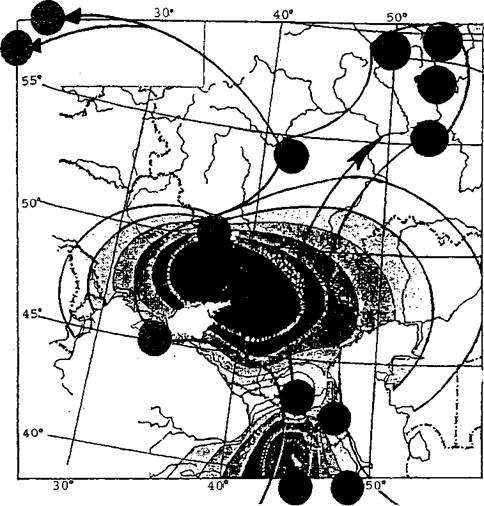
Рис. 1
Компьютерная карта распространения сердоликовых бус VIH-IXbb.(1876 экз.) в Восточной Европе с нанесением по карте Ю.Каллмера (1992) шарообразных сердоликовых бус
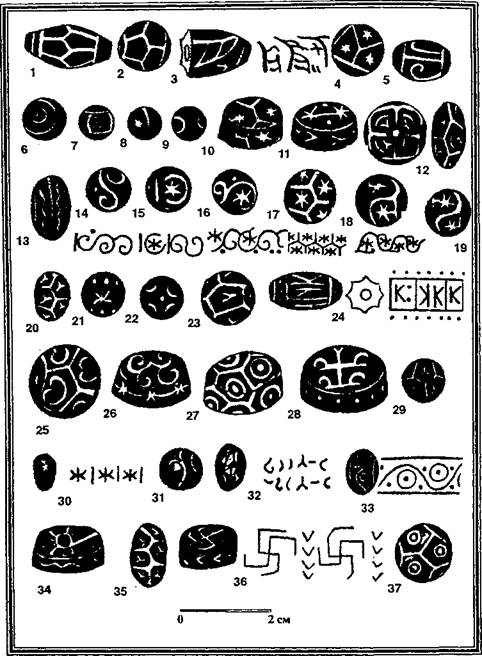
Рис. 2
Инк{^стированные халцедоновые бусы из могильников Юго-Восточной Европы VI-IX вв.: сердоликовые— 4— Балта (кат. 2); 5-8 — Чми (кат. 25); 9 — Чми (кат. 2); 10— Чми (кат. 12); 11 — Чми; 12— Терская область; 13-20— Галиат; 21, 24, 25— Комунта; 22 — Салтово; 23 — Большой Буйнакский курган; 26-28 — Кабарда; 29-30 — Архон; 31-32 — Чир-Юрт; 33 — Дергавс; 34 — Бежта; 35—Кабарда; 36-37— Мингечаур
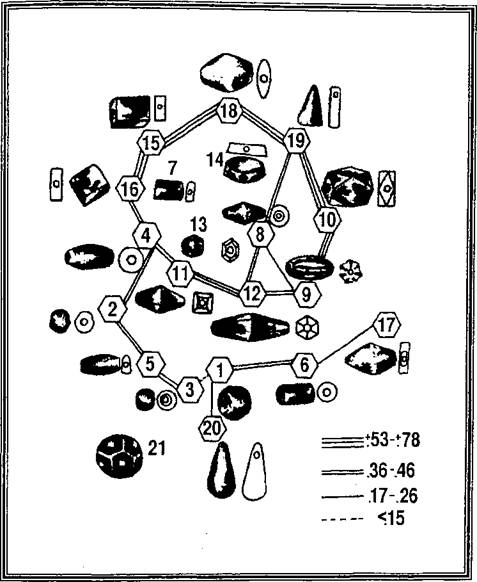
Рис. З
Связный граф сердоликовых бус V-IX вв. (по коэффициенту корреляции пространственного распределения 29665 экз.)
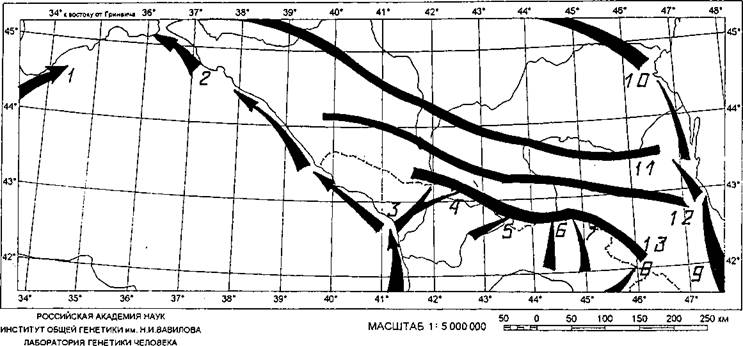
Рис. 4
Основные пути Кавказа V-IX вв. (построены по 53 картам распространения сердоликовых бус — в скобках указано количество карт): 1 — западный понтийский (из Константинополя, 9); 2— восточный понтийский (через Трапезунд, 22); 3— Великий Шелковый путь (через Клухор, 11); 4— Великий Шелковый путь (через Донгуз-Орун, 4); 5— Центрально-Кавказский (через Мамисон, 20); 6— Центрально-Кавказский (через Дар-и-Алан, 20); 7— Центрально-Кавказский (в Ичкерию, 7); 8— Восточно-Кавказский, горный (в Дагестан, 25); 9— Прикаспийский (через Дербент, 25); 10— степные широтные (19); 11 — равнинные (Терско-Кумско-Кубанские, 9); 12— средне-горные (10); 13— высокогорные (вдоль Большого Кавказа)