МІСЯЦЕСЛОВ АННИ ЯРОСЛАВІВНИ
Тридцять дві сторінки Місяцеслову - унікальний залишок рукописного Евангелія, втраченого вже перед серединою XIV ст. й доповненого у Празі глаголичним текстом еван- гельських та апостольських читань.
Історія рукопису не зафіксована і тому її доводиться реконструювати лише гіпотетично. У ньому вбачають частину Евангелія, переписаного в київському скрипторії князя Ярослава Мудрого, яке вивезла до Франції його донька Анна (Тне раніше 1075), дружина французького короля Генріха I (Т1060). Вціліла частина включає Місяцеслов на період від двадцять третьої неділі після Зіслання Святого Духа з наступним першим датованим святом 27 жовтня (9 листопада) до 27 лютого і завершується початковою частиною тексту евангельської притчі про робітників на винограднику (Мт 20 1-8). За висновком мовознавців, це найстарша розшукана досі київська редакція перекладу евангельських книг, яка випереджує кодекс новгородського посадника Остромира, переписаний у Києві в 1056-1057 роках. Водночас Місяцеслов, знаний як Реймське Евангеліє, є найстаршою оригінальною пам'яткою української книжності.Доступне у науковому світі з XVIII ст., Евангеліє київської княжни й французької королеви “загубилося” у Реймській міській бібліотеці, залишається маловідомим і зовсім не вивченим. Лише в листопаді 2009 р. у Франції з'явився його передрук з коротким популярним коментарем. Нині вперше публікуємо його в Україні у повному обсязі. Видання здійснено завдяки ініціативі Фундації Енциклопедії України в Канаді, створеної 1987 року ентузіастами «Енциклопедії Українознавства”. Фундаторами видання виступають Вожена й Олег Іванусіви та їхні доня й зять - Олена та Роман Цоби. Меценатство Іванусівих подарувало нашій культурі цілу низку фундаментальних видань, серед яких варто згадати хоча б монументальні томи “Церква в руїні”, “Церкви України - Перемиська єпархія” та “Церкви України - Закарпаття”.
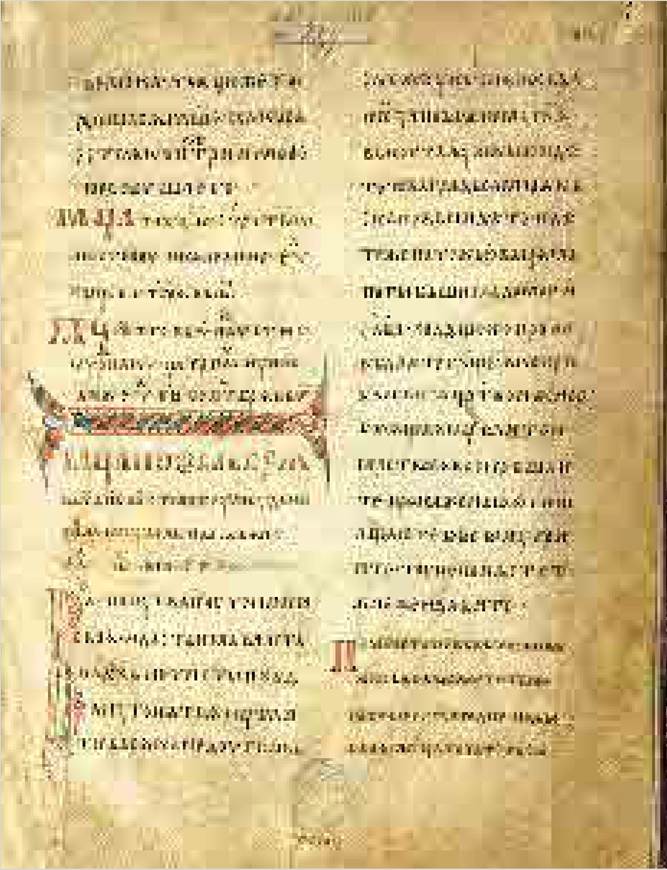
A Менологій Реймського Евангелія. Перша сторінка. А Le calendrier liturgique de I’Evangeliaire slavon de Reims. Premiere page.
A Menologion of the Reims Gospel. First page.
Видання змогло побачити світ в Україні завдяки люб'язній поставі директора Міської бібліотеки в Реймсі п. Матьє Жербо, який за посередництвом і сприянням Юрія Білака надав фотокопії унікального рукопису й виразив згоду на його репродукування. Вступний коментар написав Володимир Александрович, український переклад текстів Місяцеслову приготував о. Рафаїл Турконяк, Іван Лучук, французький переклад вступного коментаря та Місяцеслову подали о. Андрій Фіґоль та Любомир Го- сейко, а їх англійський переклад - Віра Маланчій, Олег Іванусів та о. Сергій Келегер. Тексти перекладів Місяцеслову вивірили Володимир Александрович та Іван Лучук.
Книгу приготувало до друку видавництво “Мс” під управою Зиновія Матчака та Володимира Павлю- ка.
LE CALENDRIER
LITURGIQUE D’ANNE, FILLE DU GRAND-PRINCE
YAROSLAV LE SAGE
Les trente deux pages du calendrier liturgique sont un vestige unique du manuscrit de 1’Evange- liaire perdu avant la moitie du XIVe siecle et complete a Prague par le texte glagolitique des lectures de l'Evangile et des Actes des Apotres. L'histoire du manuscrit na pas ete fixee et sa reconstruction actuelle est une hypothese. Le manuscrit apparait comme une partie de l'Evangeliaire recopie dans l'atelier des copistes kieviens du grand-prince Yaroslav le Sage et emporte en France par sa fille Anne (t apres 1075), epouse du roi de France Henri Ier (t 1060). La partie conservee comprend le calendrier liturgique pour la periode allant du vingt-troisieme dimanche apres la Pentecote avec la premiere fete datee du 27 octobre (9 novembre) au 27 fevrier et se termine par la premiere partie de la parabole evangelique des ouvriers envoyes a la vigne (Mt 20, 1-8). Les linguistes conclurent que cetait la redaction kievienne la plus ancienne qui eut ete trouvee de la traduction des livres de l'Evan- geliaire, precedant meme l'Evangeliaire d'Ostro- myr, gouverneur de Novgorod, et qui fut recopie a Kiev en 1056-1057.
En meme temps, le calendrier liturgique de l'Evangeliaire slavon de Reims est le document le plus ancien en langue ukrainienne.Connu dans les milieux scientifiques depuis le XVIIIe siecle, l'Evangeliaire de la princesse de Kiev et reine de France resta “ perdu ” dans la biblio- theque municipale de Reims. Il est peu connu et nest pas du tout etudie. Ce nest qu'en novembre 2009 qu'il fut reimprime en France avec un bref commentaire. Aujourd'hui, il est publie en entier pour la premiere fois en Ukraine. Sa publication a ete possible grace a l'initiative de la Fondation de l’Encyclopedie de I’Ukraine au Canada, fondation creee en 1987 par quelques enthousiastes de l’Encyclopedie de lUkraine. La publication a ete finan- cee par Bozhena et Oleh Iwanusiw ainsi que leurs fille et gendre - Olena et Roman Coba. Le mecenat des Iwanusiw a offert a notre culture toute une se- rie de publications fondamentales parmi lesquelles il convient de noter les volumes monumentaux LEglise en ruine, Les eglises de I’Ukraine - le diocese de Peremysl et Les eglises de l’Ukraine - la Transcarpatie.
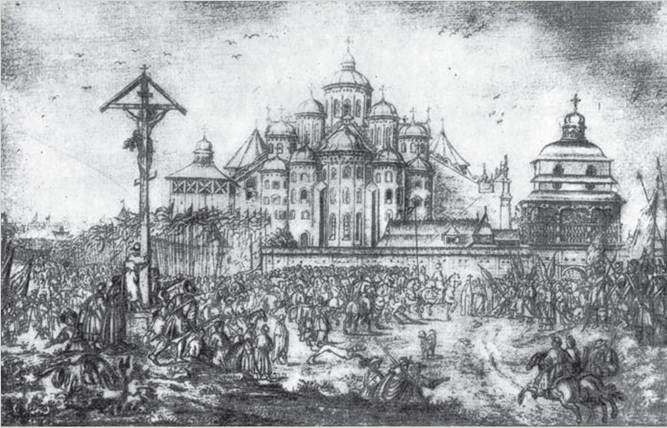
A Абрагам ван Вестерфельд.
Софійський собор у Києві. Вигляд зовні. 1651. A Abraham Van Westerfeld. Cathedrale Sainte-Sophie a Kiev. Vue de lexterieur, 1651. A Abraham Van Westerfeld. Cathedral of Saint Sophia in Kyiv. Exterior view, 1651.
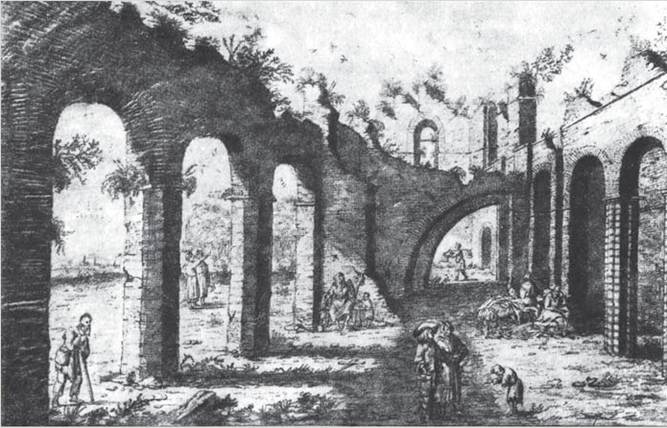
V Абрагам ван Вестерфельд. Софійський собор у Києві. Зовнішня галерея від півдня. 1651.
V Abraham Van Westerfeld. Cathedrale Sainte-Sophie a Kiev. Galerie exterieure du cote sud, 1651.
V Abraham Van Westerfeld. Cathedral of Saint Sophia in Kyiv. Exterior gallery, view from the south, 1651.
Cette publication a ete possible en Ukraine grace au directeur de la bibliotheque municipale de Reims Matthieu Gerbault qui par l’intermediaire et avec le concours de Yuriy Bilak a offert les photocopies du manuscrit unique et a donne son accord pour sa reproduction.
Le commentaire d’introduction a ete ecrit par Volodymyr Aleksandrovych, la traduction ukrainienne des textes du calendrier liturgique a ete faite par le pere Raphael Turkoniak, Ivan Luchuk, la traduction vers le francais du commentaire d’introduction et du calendrier liturgique a ete faite par le pere Andrij Figol et Liubomyr Hoseyko. La traduction vers l’anglais a ete faite par Vira Malanczyj, Oleh Iwanusiw, le pere Serge Keleher.La relecture des textes du calendrier liturgique a ete assuree par Volodymyr Aleksandrovych et Ivan Luchuk. Le livre a ete prepare pour la publication par les editions “ Mc ” sous la direction de Zynoviy Matchak et Volodymyr Pavliuk.
THE MENOLOGION
OF ANNA YAROSLAVIVNA
This thirty two page Menologion is the oldest preserved relic of the Kyivan School of Scripture lost from before the middle of the eleventh century and supplemented in Prague with Evangelical and Apostolic readings in hlaholian script. There is no recorded history of the fragment and only a hypothetical one can be reconstructed. It appears to contain a part of the Gospel prepared in the Scriptorium of Yaroslav the Wise and brought to France by his daughter, Anna Yaroslavivna, who became the wife of King Henry I. The recovered fragment of the Monologion covers the period from the twenty-third Sunday after Pentecost, the next feast day being dated October 27th (November 9th), to February 27th and ends with the first section of the Evangelical parable about the workers in the vineyard (Matthew 20: 1-8). Scholars have concluded that to date this is the oldest discovered example of the Kyivan translation of the Gospel. It is even older than the well known Ostromyr Gospel a copy of which was made in Kyiv in 1056-1057. This Monologion of the Reims Gospel is the oldest original relic of Ukrainian written language.
Known to scholars from the 18th century, the Gospel of the Kyivan princess remained “lost” in the Reims Public Library, and therefore, has not been studied.
It wasn't until November 2009 that it was reprinted in France with a short commentary. Today the first complete manuscript is being published in Ukraine. This publication is the initiative of the Foundation of the Encyclopedia of Ukraine in Canada which was established in 1987 by enthusiasts of the “Encyclopedia of Ukraine”. Bozhena and Oleh Iwanusiw and their daughter and sonin-law - Olena and Roman Coba are sponsoring the publication. Through their patronage, the Iwa- nusiw's have added a number of fundamental publications to Ukrainian culture. Among them are - Church in Ruins, Churches of Ukraine - Peremyshl Eparchy and Churches of Ukraine - Zakarpattia - to name but a few.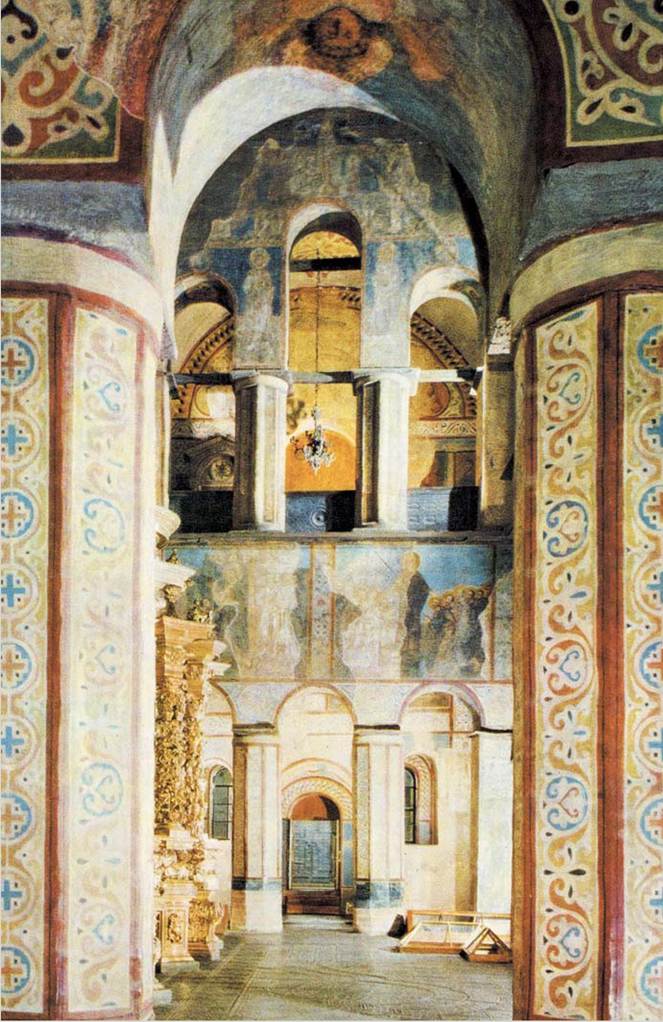
А Софійський собор у Києві. Вигляд від північного входу на південний трансепт.
A Cathedrale Sainte-Sophie a Kiev. Vue de I’entree nord sur le transept sud.
A. Cathedral of Saint Sophia in Kyiv. The south transept viewed from the north entrance.
Many thanks must be given to the Reims Public Library and its director, Mr. Matthieu Gerbault, for providing a fine digital copy of the original manuscript and giving permission to publish it. It was actually Yuriy Bilak, a French photo artist of Ukrainian origin, who.was successful in finding the original in the Reims Public Library. He obtained and sent the digital copy of it to Oleh Iwa- nusiw. Hence it was possible to take the project further and publish it in book format. The preface was written by Volodymyr Aleksandrovych. The preparation of the Ukrainian text was done by Reverend Rafael Turkoniak Ivan Luchuk. The preface and the French text were written by rev. Andriy Figol and Liubomyr Hoseyko. The English translation was done by Vera Malanczyj, Oleh Iwanusiw, rev. Serge Keleher.
The translation of the Menologion was verified by Volodymyr Aleksandrovych and Ivan Luchuk. The book is being published by “MC” Publishers under the management of Zynoviy Matchak and Volodymyr Pavliuk.